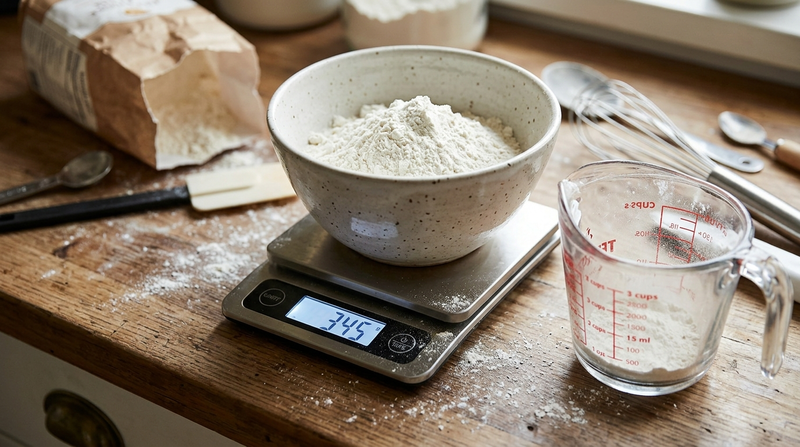
Measuring cups are fast, familiar and mostly good enough for soup. For baking, they are a gamble. Two people can scoop a cup of flour and end up with amounts that differ by 20 percent or more, which is enough to turn a soft cake into a dry one. A kitchen scale solves that, and a decent one costs about the price of a sandwich.
Why cups are inconsistent
Dry ingredients compress. If you dip a measuring cup into a bag of flour, you pack it down, and it can hold noticeably more flour than a cup that was lightly spooned and leveled. The same goes for cocoa powder, powdered sugar and brown sugar. Weight does not change with how firmly something is packed.
What a scale gives you
- Consistency. The same recipe works the same way every time.
- Fewer dishes. Place the mixing bowl on the scale, press the tare button to reset to zero, add ingredient one, tare again and add the next. No measuring cups to wash.
- Easy scaling. Halving or doubling a recipe is simple math when everything is in grams.
- Access to better recipes. Many bread, pastry and international recipes are written by weight.
Common weights to know
These are approximate and vary slightly by brand and how the ingredient is milled:
- All-purpose flour: 1 cup is about 120 to 125 g
- Granulated sugar: 1 cup is about 200 g
- Packed brown sugar: 1 cup is about 210 g
- Powdered sugar: 1 cup is about 115 to 120 g
- Butter: 1 stick (½ cup) is 113 g
- Cocoa powder: 1 cup is about 85 to 90 g
- Rolled oats: 1 cup is about 90 g
- Water or milk: 1 cup is about 235 to 240 g
- Honey: 1 cup is about 340 g
When a recipe gives weights, trust them over cup measures.
Dry and liquid cups are different tools
If you are still using cups, use the right kind. Dry measuring cups are filled to the brim and leveled off with a knife. Liquid measuring cups have a spout and a line below the rim, and should be read at eye level on a flat surface. Using a dry cup for liquid, or the reverse, gives less accurate results.
How to measure flour properly without a scale
- Stir or fluff the flour in its container.
- Spoon it lightly into the measuring cup until it is heaped over the top. Do not tap or press.
- Level it off with the back of a knife.
This is much better than scooping, though still not as exact as weighing. More on flour types and behavior in our guide to flour types.
What to look for in a scale
- A tare function, which is essential.
- Capacity of at least 5 kg (11 lb), to handle a heavy bowl and ingredients.
- Accuracy to 1 gram, with a 0.1 g scale only needed for things like yeast and spices in tiny amounts.
- A flat, easy-to-clean surface, and a display not hidden by a large bowl.
- Auto-off that is not too aggressive, so it does not shut off mid-recipe.
- A unit switch between grams and ounces.
When cups are fine
Soups, stews, sauces, rice and salads are forgiving. A little more or less broth or chopped vegetables will not ruin dinner. Save the precision for baking, candy making, bread and anything where proportions matter, such as the cookies in our guide to why cookies spread.
Getting started
Pick a favorite baking recipe, weigh the ingredients once while you make it, and write the grams next to the cup amounts. Next time, use the weights. After a few recipes, you will have your own reference sheet, and you may not go back to cups for baking.
Converting a cup-based recipe to grams
You do not need to convert everything at once. The next time you bake a recipe you like, put the bowl on the scale and measure each ingredient as you add it, writing down the weight beside the cup amount. Use your own scooping style the first time, so the written number matches the result you already enjoyed. After that, bake by weight. If the loaf or cookies come out slightly different, adjust the flour by 10 grams and note it. Over a few bakes you will have a recipe that works precisely in your kitchen.
For small amounts such as yeast, baking powder or spices, spoons are still more practical than a standard scale. Use level measures, and make sure leaveners are fresh.