A dull knife is more dangerous than a sharp one. It needs more pressure, slips off tomato skins and onions, and is more likely to end up in your thumb. The good news is that keeping knives sharp is a simple habit. It starts with understanding that honing and sharpening are two different jobs.
Honing versus sharpening
Honing straightens the edge. With use, the thin cutting edge of a knife bends microscopically to one side, which feels like dullness. Running the blade along a honing rod pushes it back into line. Honing removes almost no metal, and you can do it often.
Sharpening grinds away a thin layer of steel to create a new edge. This is what you need when honing no longer helps. Sharpening wears down the blade a little each time, so it is done only a few times a year.
How often
- Hone: every few uses, or whenever the knife feels slightly off.
- Sharpen: once or twice a year for a home cook, more often with heavy daily use.
A simple test: try slicing a ripe tomato. A sharp knife glides through the skin with almost no pressure. If it slides or squashes, hone first. If honing does not fix it, sharpen.
How to hone
- Hold the honing rod upright with the tip resting on a folded towel on the counter.
- Place the heel of the blade against the top of the rod at a shallow 15 to 20 degree angle, lower than most people expect.
- Draw the blade down and across the rod toward the tip, with light pressure, as if slicing a thin piece off the rod.
- Repeat on the other side. Five to ten strokes per side is plenty.
- Wipe the blade clean.
Consistent angle matters more than speed. Slow is fine.
How to sharpen on a whetstone
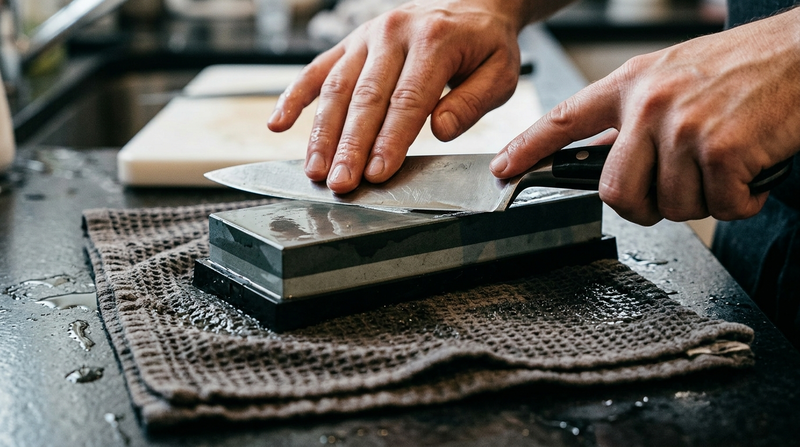
Whetstones give the best results and are not as difficult as they look. A combination stone with a coarser side (around 1000 grit) and a finer side (around 3000 to 6000 grit) covers most needs.
- Soak the stone in water if the instructions call for it, usually 10 to 15 minutes. Set it on a damp towel or non-slip base so it does not move.
- Start on the coarse side. Hold the knife at about 15 to 20 degrees, with the edge facing away from you.
- Push the blade across the stone as though you were trying to slice a thin layer off its surface, moving from heel to tip. Use light, even pressure and keep the angle steady.
- Do about 10 to 15 strokes on one side, then check for a burr, a tiny curl of metal you can feel along the opposite edge with your fingertip (touch carefully, from the spine toward the edge, never along it).
- Flip the knife and repeat on the other side until you feel a burr on the first side again.
- Move to the fine side and do a few lighter strokes on each side to polish the edge.
- Wash and dry the knife thoroughly, and hone it lightly to finish.
Other sharpening options
- Pull-through sharpeners: quick and convenient, but they remove more metal and cannot match a stone’s precision. Fine for inexpensive knives.
- Electric sharpeners: fast and consistent, and good for beginners, though some are aggressive on the blade.
- Professional sharpening: many hardware stores, kitchen shops and farmers’ markets offer it for a small fee. A good choice for expensive knives or if you do not want to learn the stone.
Habits that keep knives sharp longer
- Cut on wood or plastic boards. Glass, marble and stone dull a blade almost instantly.
- Wash knives by hand and dry them right away. Dishwashers bang blades against other items and can damage handles.
- Store them in a knife block, on a magnetic strip or in blade guards, not loose in a drawer.
- Do not use the knife to scrape food off a board with the edge. Flip it over and use the spine.
- Do not cut through bones, frozen foods or hard shells with a general-purpose knife.
Which knives do you really need?
A chef’s knife, a paring knife and a serrated bread knife handle almost every job. If you are going to maintain only one knife well, make it the chef’s knife. Pair it with a stable surface and good habits, covered in our guide to cutting board safety.