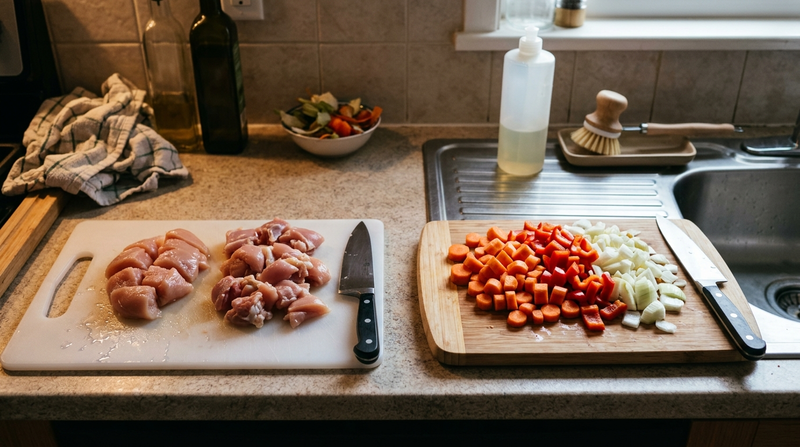
Food safety does not need to be complicated. Most home food poisoning comes from a short list of avoidable things, and one of the most common is cross-contamination, which is when bacteria from raw meat, poultry, seafood or eggs end up on food that will not be cooked afterward. Your cutting board is one of the places this happens most easily.
What cross-contamination looks like
You chop raw chicken on a board, give it a quick rinse, then slice tomatoes for a salad on the same board. Any bacteria left behind move onto the tomatoes, which nobody is going to cook. The same can happen with knives, hands, sponges and countertops.
Use separate boards
The simplest fix is two or more boards:
- One for raw meat, poultry and seafood.
- One for produce, bread, cheese and anything eaten raw.
Color coding helps. Many kitchens use a red board for raw meat and a green one for vegetables. If you only have one board, prepare produce and ready-to-eat foods first, then wash the board properly before handling raw meat.
How to clean a board properly
- Wash it with hot, soapy water right after use, scrubbing both sides and the edges.
- Rinse well.
- For extra safety after raw meat, sanitize. The U.S. Department of Agriculture suggests a solution of one tablespoon of unscented liquid chlorine bleach per gallon of water. Flood the surface, let it sit for several minutes, then rinse with clean water.
- Air-dry upright, or dry with a clean towel.
Plastic boards can usually go in the dishwasher, where the high temperature helps. Wooden boards should not be soaked or run through the dishwasher, which causes warping and cracking.
Wood or plastic?
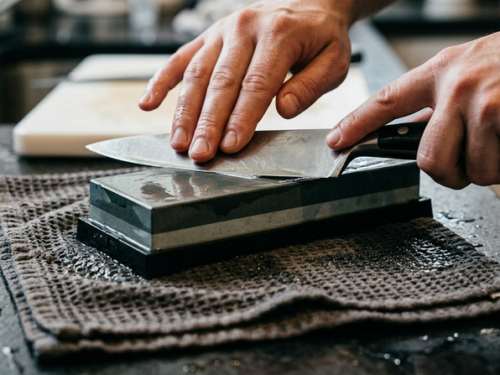
Both can be safe if cleaned properly. Wood is gentler on knife edges and looks nice, but needs more care. Occasionally rub a food-safe mineral oil into the surface to keep it from drying and cracking. Plastic is lighter, dishwasher-safe and cheaper, but deep grooves can trap bacteria and make cleaning harder. Avoid glass and stone boards, which dull knives quickly and can be slippery. For knife care, see our guide to honing and sharpening.
When to replace a board
If a board has deep knife grooves that are hard to scrub clean, cracks, or stubborn stains and odors that remain after washing, it is time to replace it. Plastic boards are inexpensive to replace. Wood boards can sometimes be sanded smooth.
Other habits that matter
- Do not rinse raw chicken. Washing it splashes bacteria around your sink and counter, and does not make the chicken safer. Cooking to the right temperature does.
- Wash your hands with soap and water for at least 20 seconds after touching raw meat, and before touching other foods.
- Use a clean knife and utensils for ready-to-eat food, or wash them between tasks.
- Do not reuse raw marinade as a sauce unless it has been boiled first.
- Replace dishcloths and sponges often, or wash them on a hot cycle. Wet sponges harbor bacteria.
- Store raw meat on the bottom shelf of the refrigerator in a container, so juices cannot drip onto other foods.
- Use a thermometer to check cooked meat. Poultry should reach 165°F, ground meat 160°F and whole cuts of beef, pork and lamb 145°F with a three-minute rest.
Clean as you go
Keep a bowl or tray nearby for raw packaging and scraps, wipe the counter after handling raw meat and keep a clean towel for hands separate from the one for dishes. It takes seconds and fits naturally into the prep habits we describe in our guide to reading a recipe and setting up your station.
A note on the danger zone
Bacteria multiply fastest between 40°F and 140°F (4°C and 60°C). Do not leave perishable food out for more than two hours, or one hour if it is above 90°F outdoors. Put leftovers into shallow containers and refrigerate promptly.
Other surfaces to watch
Boards are only part of the picture. Raw juices can reach the knife handle, the faucet, the refrigerator door, a spice jar or your phone. Get in the habit of washing your hands and wiping down the areas you touched after handling raw meat, before touching anything else.
Fruits and vegetables should be rinsed under running water before cutting, even if you plan to peel them, so that dirt on the surface is not carried inward by the knife. Soap and produce washes are not necessary. Firm produce such as melons and potatoes can be scrubbed with a clean brush. Dry the produce with a clean towel to reduce bacteria further.