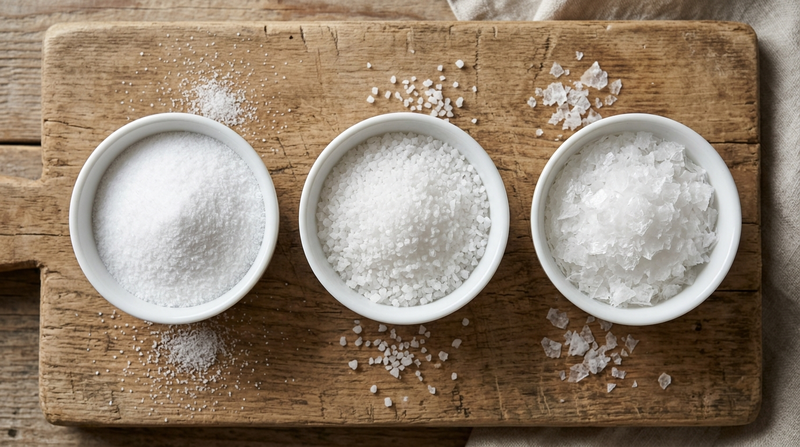
Chemically, nearly all cooking salt is the same thing: sodium chloride. So why do recipes specify the type, and why does a dish sometimes turn out too salty when you swap one for another? The difference is physical. Crystal size and shape change how much salt fits in a spoon, how fast it dissolves and how it feels when it hits your tongue.
Why the same teaspoon is not the same amount
A teaspoon of fine table salt packs tightly, with very little air between the crystals. A teaspoon of coarse, flaky kosher salt has a lot of air in it, so it holds less actual salt. That is the whole reason substitutions go wrong. If a recipe was written with a coarse salt and you use the same volume of fine salt, you will add noticeably more salt than intended.
Brands of kosher salt also differ from each other. Diamond Crystal has hollow, light flakes. Morton kosher salt is denser. As a rough guide, you need about half the volume of table salt compared with Diamond Crystal, and about two-thirds compared with Morton. Treat these as starting points and taste as you go. Weighing salt on a kitchen scale removes the guesswork entirely.
The main types
Table salt
Fine grains, usually with an anti-caking agent and often with added iodine. It dissolves quickly, which makes it the usual choice for baking, where accuracy matters and the salt needs to disperse evenly. Some people notice a slightly sharper taste from the additives.
Kosher salt
Coarse and flaky, with no iodine in most brands. Cooks like it because it is easy to pinch and sprinkle, and it is easy to see where it lands on the food. It is the everyday workhorse for seasoning meat, vegetables and pasta water. Note that the name refers to its use in koshering meat, not to the salt being certified in itself.
Sea salt (fine or coarse)
Made by evaporating seawater. Fine sea salt behaves like table salt in recipes. Coarse sea salt works well in a grinder or for seasoning large cuts of meat. Trace minerals are present but in amounts that do not change flavor much when the salt is dissolved into a dish.
Flaky finishing salt
Thin, crisp flakes such as Maldon. These are for sprinkling on at the end, on a steak, a salad, a slice of tomato or the top of a cookie. The crunch and burst of salt are the point. Cooking them into a dish wastes the texture.
Specialty salts
Smoked salt, flavored salts and mineral-rich pink or gray salts are all good for finishing, but they cost more and rarely make a difference when mixed into a stew. Save them for the plate.
Which salt for which job
- Everyday cooking and seasoning: kosher salt
- Baking: fine salt, measured by weight if possible
- Pasta water: any salt, enough that the water tastes pleasantly salty
- Brining and curing: use the type the recipe names, and weigh it
- Finishing: flaky salt
When to add salt
Salt seasons best when it has time. Season meat well before cooking, even 40 minutes ahead, and it will taste seasoned through, not just on the surface. In soups and sauces, add a little at each stage and taste at the end. Reducing liquids concentrates saltiness, so adding all of it at the start can leave a sauce too salty once it has simmered down. Our guide on searing meat also explains why salting ahead helps browning.
How to fix an over-salted dish
- Add more of the unsalted ingredients, such as more broth, cooked rice, beans or vegetables, to dilute.
- Add a splash of acid, like lemon or vinegar. It does not remove salt, but it balances how salty the dish tastes.
- A little fat, such as cream or butter, can soften the edge.
The popular idea that dropping a raw potato into the pot absorbs the salt does not work well. A potato absorbs liquid in proportion to the rest of the dish, not extra salt.
A practical tip
Choose one everyday salt and learn it. Keep it in a small bowl or wide jar next to the stove so you can pinch it with your fingers. Using the same salt every time teaches you what a pinch does, and that is more valuable than any exact measurement.