By Harry Cruse | TasteSavory
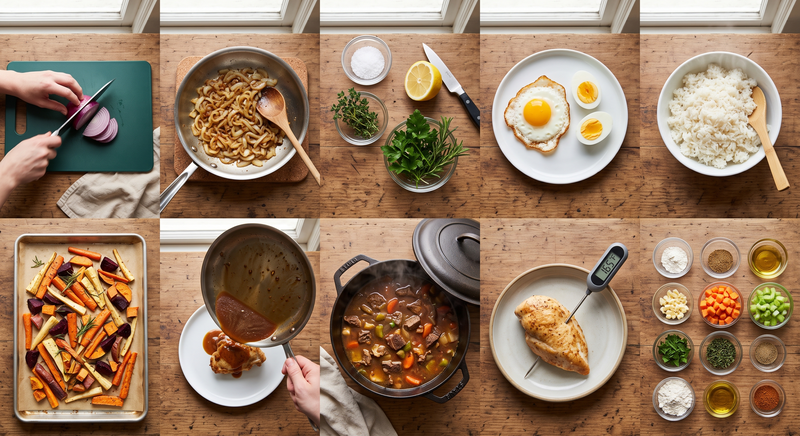
When beginners ask experienced cooks which skills matter most, the answers are surprisingly consistent. Nobody says you need to master a dozen fancy techniques. They say to learn to use a knife safely, control your heat, season and taste, cook a few simple things well, keep food safe, and plan your time. Some even argue that five solid skills are plenty. This guide pulls those answers together into ten skills, explains what to learn within each one, and ends with a ten-dish practice plan, so you can build the skills by cooking real food and not just reading about it. It focuses on skills, which means techniques you practice, and it pairs well with our cooking habits guide, which covers the routines that make every meal better.
The short answer
- Start with the foundations: knife skills, heat control, and seasoning with tasting.
- Learn a few simple foods that teach those skills, such as eggs, rice, roasted vegetables, and a pan sauce.
- Learn the basic food-safety rules early, because they protect everyone who eats your cooking.
- Practice with real dishes, and expect some mistakes. That’s how the skills stick.
- Don’t try to learn everything at once. Pick one skill a week.
What experienced cooks agree on
Even in a lively debate, a few points come up again and again. Transferable techniques matter more than any particular dish, since you don’t need to master steak if you never eat it, but the heat control behind it applies everywhere. Baking is a separate set of skills, with its own lessons about measuring and oven temperature. And the best way to learn is to cook the dishes you and your family already love, because you already know what they should taste like, which makes it easier to notice what’s off. With that in mind, here are the ten skills.
Skill 1: Use a knife safely and confidently
Most beginners are slowed down by their knife, not their recipes. Learn these basics:
- Stabilize the board. Put a damp towel under it so it doesn’t slide.
- Use the claw grip. Curl the fingertips of your guiding hand inward, and let the flat of the blade rest against your knuckles.
- Cut with a flat surface. Slice a rounded vegetable in half first so it lies flat and doesn’t roll.
- Keep the knife sharp. A dull knife needs more force and slips more easily. Hone it regularly, and sharpen it when honing stops helping.
- Go slowly. Speed comes with practice. Even professionals aren’t impressed by fast, sloppy cutting.
Practice it: Dice an onion, a carrot, and a stalk of celery for a soup. Our essential kitchen tools guide explains what knife to buy first.
Skill 2: Control heat and sauté
Sautéing means cooking small pieces of food in a little fat, uncovered, over fairly high heat. The rules are simple but easy to forget:
- Preheat the pan before the food goes in.
- Use enough fat to coat the surface.
- Don’t crowd the pan, or the food steams instead of browning.
- Match the heat to the food: high for browning, medium for softening, low for gentle cooking.
- Leave the food alone long enough to brown, and stir when it needs it.
You’ll learn the most from foods that are easy to read, such as onions, which go from raw to translucent to golden. For why browning builds flavor, see flavor and color in cooking.
Skill 3: Season and taste as you go
Many experienced cooks say learning to use salt is the first skill to master. Ask three questions: when to add it, what to add it with, and how much. Salt added early builds flavor all the way through, and a final adjustment fine-tunes it. Salt doesn’t only come from the shaker, since soy sauce, Parmesan, and broth all contribute. You will only learn the right amount by sometimes under-salting and over-salting, so don’t be afraid of mistakes, and taste at every stage. If a dish is flat, add salt first, then a little acid such as lemon juice. Spices need attention too. Replace old jars, and as a general guide, add whole spices first, then ground spices, then dried herbs, and finish with fresh herbs. Our guide to toasting and blooming spices shows how.
Practice it: Taste a pot of plain broth, add salt in small steps, then add a squeeze of lemon, and notice the difference at each stage.
Skill 4: Cook eggs
Eggs are a cheap, fast way to learn heat control. Learn four preparations: scrambled, fried, an omelet, and hard-boiled. For hard-boiled eggs, cover large eggs with cold water by about an inch, bring to a boil, turn off the heat, cover, and let them stand for 12 minutes, then cool them in ice water. Each style teaches something. Scrambled eggs teach low heat and timing, fried eggs teach pan preparation, and an omelet teaches you to remove food from the heat at the right moment. Our guide to cooking eggs without sticking covers all of them, and a fried egg goes on a BLT or a rice bowl.
Skill 5: Cook rice, pasta, and other grains
Grains teach you to follow a ratio and a timer. For long-grain white rice, a common starting ratio is 1 cup of rice to about 1½ cups of water, but follow the package, since types vary. Rinse the rice until the water runs mostly clear, bring it to a boil, reduce the heat to its lowest setting, cover tightly, and cook for about 15–18 minutes. Then let it rest, covered, for 10 minutes, and fluff it with a fork. Don’t lift the lid while it cooks. A basic rice cooker does the same job with less attention and is a reasonable early purchase. For pasta, salt the water generously, and save a cup of the cooking water to loosen the sauce, as described in our habits guide. Refrigerate leftover rice promptly, within 2 hours.
Skill 6: Roast vegetables and meat
Roasting is one of the easiest ways to get good flavor, because the oven does most of the work. For vegetables, cut them into even pieces, toss with oil and salt, spread them in a single layer with space between pieces, and roast at about 425°F (220°C). Broccoli and cauliflower often take 20–25 minutes, carrots 25–35, and 1-inch potato chunks 30–40, turning once. For meat, use a thermometer, take it out when it reaches the safe temperature, and let it rest. Our ways to cook meat and ways to cook chicken guides explain which cuts to roast and how.
Skill 7: Make a few simple sauces
Sauces turn plain food into a meal. You don’t need a long list. Three cover a lot of ground:
- A vinaigrette: Oil, acid, mustard, and salt. It dresses salads and vegetables.
- A pan sauce: After searing meat, add wine, broth, or lemon to the hot pan, scrape up the browned bits, and simmer to reduce.
- A roux-thickened sauce: Cook equal parts butter and flour, then whisk in milk or stock. It’s the base of béchamel, gravy, and creamy soups.
A basic tomato sauce is also useful, though jarred sauce is a fine shortcut when you’re short of time. Our six essential sauces have the recipes.
Skill 8: Simmer, braise, and make soup
Low-and-slow cooking is forgiving and teaches patience. Learn the basic pattern: brown the food in a pot, soften the aromatics, add liquid, and simmer gently, partially covered, until tender. Tough cuts such as chuck, short ribs, and chicken thighs turn tender this way, and soups and chili follow the same steps. Taste as it cooks, and adjust the salt and acid at the end. If the pot is thin, our guide to thickening soup, stew, and chili offers ten fixes. Practice with our easy beef chili.
Skill 9: Handle food safely
Several experienced cooks say this should come before any fancy skill, and they’re right. The basics are short:
- Cook to safe temperatures: 165°F (74°C) for poultry, 160°F (71°C) for ground meat, and 145°F (63°C) for steaks, chops, and fish. See our thermometer guide.
- Keep cold food cold and hot food hot: Refrigerator at 40°F (4°C) or below, and hot food at 140°F (60°C) or above.
- Don’t leave food out more than 2 hours, or 1 hour above 90°F (32°C).
- Prevent cross-contamination: Separate boards and tools for raw meat, and wash your hands often.
- Thaw safely and cool leftovers fast: Thaw in the refrigerator or cold water, and refrigerate leftovers in shallow containers.
Our guide to storing food in the kitchen covers the details. Many health departments and training providers also offer short food-safety courses online, which can be useful if you want more depth.
Skill 10: Read a recipe, plan, and manage your time
The last skill is organizational. Read the whole recipe before you start. Set out and prepare every ingredient first, which cooks call mise en place, so you aren’t chopping while something burns. Plan the order of work, so the long-cooking items start first and everything finishes together. Clean as you go, and use the oven for sheet-pan meals when your stovetop is full. Pair a main dish that needs constant attention with a side that you can leave alone. Shop for the amount you’ll actually use, so food doesn’t go to waste, and see our meal prep guide for batch cooking. Start with tested recipes from sources you trust, and change them once you understand why they work. Be cautious about changing baking recipes, which are less forgiving.
A word on baking
Baking is a separate skill set, built on accurate measuring, oven temperature, and mixing. Learn one simple recipe well, such as cookies or a quick bread, before you try anything fancier. Our baking tips for beginners explain the habits that prevent most failures, and our banana bread is a good first loaf.
A ten-dish practice plan
Cook one of these each week or two, and you’ll practice every skill above. Choose recipes your household already likes where you can, since familiar flavors make mistakes easier to spot.
| Dish | Skills it teaches | Where to start |
|---|---|---|
| Scrambled eggs and an omelet | Heat control, timing | Cooking eggs without sticking |
| Sheet-pan roasted vegetables | Knife skills, roasting, seasoning | 425°F, in a single layer |
| Rice with soy-ginger vegetables | Grains, sautéing, sauces | Essential sauces |
| Chicken cutlets with a lemon pan sauce | Sautéing, pan sauce, thermometer | Juicy chicken breast |
| Tomato sauce and pasta | Simmering, seasoning, pasta water | Garlic Parmesan pasta |
| Burgers | Safe temperatures, handling | Restaurant-style burgers |
| Roasted vegetable soup | Roasting, blending, seasoning | Butternut squash soup |
| Chili | Browning, blooming spices, simmering | Easy beef chili |
| Braised chicken thighs or pot roast | Braising, patience | Ways to cook meat |
| Banana bread or cookies | Measuring, baking | Moist banana bread |
Common beginner problems and fixes
| Problem | Likely cause | What to try |
|---|---|---|
| Food sticks to the pan | The pan wasn’t preheated, there was too little fat, or the food was moved too soon | Preheat, add enough fat, and wait until it releases |
| Everything tastes bland | Not enough salt or acid | Season in stages, taste, and finish with lemon or vinegar |
| Vegetables are soggy, not browned | Crowded pan or a wet surface | Dry them, use more space, and use higher heat |
| Burnt outside, raw inside | Heat too high for the thickness | Lower the heat, or finish in the oven |
| Dry chicken or pork | Overcooked | Use a thermometer and rest the meat |
| Dinner is never ready at the same time | Poor sequencing | Read the recipe first, start the longest item first, and use the oven |
FAQ
How long does it take to learn to cook?
Most people feel comfortable with the basics after a few months of regular cooking. Skills build on each other, and the more often you cook, the faster they come.
Do I need expensive equipment?
No. A sharp chef’s knife, a heavy skillet, a pot, a sheet pan, and a thermometer cover most of what’s here. See our essential kitchen tools.
Should I follow recipes or learn without them?
Start with good recipes, which work like training wheels and give consistent results. As you understand why each step matters, you can start adjusting them.
What if I’m cooking just for myself?
Everything here scales down. Cook a little extra of the basics, such as rice, roasted vegetables, or a sauce, and use them across several meals.
Conclusion
Cooking isn’t a single talent. It’s a handful of skills that you build one at a time: a sure hand with a knife, steady heat, good seasoning, a few reliable dishes, safe habits, and a plan. You don’t have to master all ten before you start. Choose the first dish from the practice plan, cook it this week, and notice what went well and what didn’t. Then pick the next one.