By Harry Cruse | TasteSavory
Walk into any kitchen store and you’ll find a tool for everything: an egg slicer, an avocado splitter, a dedicated watermelon scooper. Most of them spend their lives in a drawer. The tools that earn their place tend to be plain, sturdy, and useful for many jobs, and home cooks who’ve been through a few rounds of buying and purging tend to end up with the same short list. This guide sorts kitchen equipment into three groups: the core tools worth buying first, upgrades worth adding when you need them, and gadgets you can usually skip. It also covers how to choose, care for, and store what you buy.
The short answer
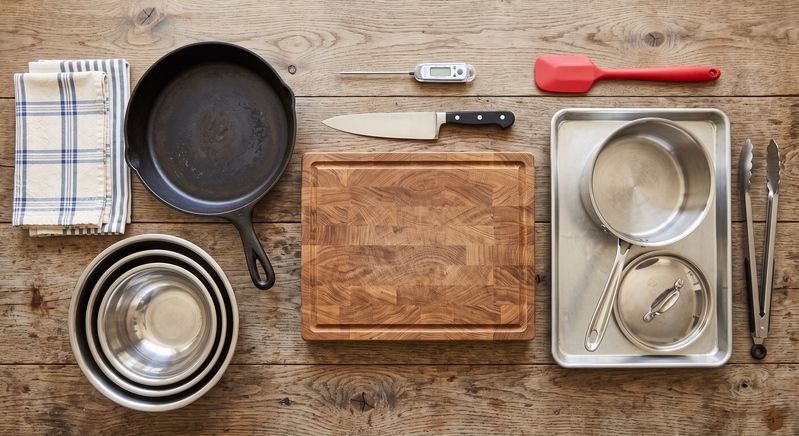
- Start with a sharp chef’s knife, a cutting board, a sturdy pan or two, a pot, a sheet pan, and an instant-read thermometer.
- Choose tools that do several jobs and are easy to clean.
- Buy one tool at a time, when you notice a real need, not all at once.
- Skip single-purpose gadgets unless you’ll use them every week.
- Good tools don’t have to be expensive, but very cheap knives and pans can cost you more in frustration.
How to decide whether a tool is worth it
Before buying anything, ask four questions. Will I use it at least weekly? Does it do more than one job? Is it easy to clean? Do I have room to store it? A tool that fails most of these questions is usually clutter. Also consider how you actually cook. Someone who bakes bread every weekend needs different things from someone who mostly makes stir-fries. A tool that’s essential in one kitchen can be useless in another.
Core tools to buy first
| Tool | What it’s for | What to look for |
|---|---|---|
| Chef’s knife (about 8 inches) | Nearly all chopping, slicing, and dicing | A comfortable grip and a blade you can sharpen. Some cooks prefer a vegetable cleaver for the same jobs |
| Cutting boards | A safe, stable surface for prep | A large board that doesn’t slide, and a separate one for raw meat |
| Skillet, 10–12 inches | Searing, sautéing, frying, pan sauces | Stainless steel, cast iron, or carbon steel for browning |
| Nonstick pan | Eggs, delicate fish, pancakes | An inexpensive one is fine, since it’s replaced periodically |
| Saucepan and large pot | Sauces, grains, soups, pasta, stocks | A heavy base, a tight lid, and handles that stay secure |
| Sheet pan | Roasting, baking, reheating, cooling | Heavy-gauge metal that resists warping, with a rimmed edge |
| Instant-read thermometer | Meat, fish, leftovers, bread, and cakes | A fast, readable display. See our thermometer guide |
| Tongs | Turning meat, tossing pasta, lifting hot food | All-metal, spring-loaded, and easy to clean |
| Spatulas | Flipping, scraping, stirring | A heat-resistant silicone spatula, and a thin metal or fish spatula for fish and eggs |
| Mixing bowls | Mixing, prep, marinating, holding ingredients | Stainless steel bowls are light, durable, and inexpensive |
| Kitchen towels | Drying, wiping, handling hot pans | A stack of plain cotton towels |
This list covers most everyday cooking. If you’re only buying three things at first, make them a good knife, a heavy skillet, and a thermometer. Our guide to ways to cook meat shows how much the right pan and a thermometer can change your results.
Worth adding when you need them
- Kitchen scale: The best tool for baking accuracy, since it removes the variation between cups of flour. It also means fewer dishes to wash. See our baking tips for why it matters.
- Dutch oven: A heavy, lidded pot for braising, soups, stews, and baking bread, such as the pot roast in our meat guide.
- Wire rack: Sits inside a sheet pan so air circulates under roasted or baked food, which helps it crisp. It also cools baked goods.
- Fine-mesh strainer: Drains, rinses, sifts flour, and strains sauces.
- Microplane grater: Zests citrus and finely grates garlic, ginger, hard cheese, and nutmeg.
- Vegetable peeler: An inexpensive Y-shaped peeler is fine. Replace it when it dulls.
- Kitchen shears: Cut herbs, trim poultry, snip packaging, and more. Choose a pair that comes apart for cleaning.
- Bench scraper: Moves chopped food from board to pan, divides dough, and scrapes the counter.
- Immersion blender: Blends soups directly in the pot, as in our roasted butternut squash soup. Keep the blade submerged and use a pot deep enough to avoid splashing, since hot liquid can burn.
- Stackable storage containers: Uniform, stackable containers with matching lids make leftovers and meal prep easier. Choose ones labeled microwave-safe if you’ll reheat in them. See our guide to storing food for how to use them.
Depends on how you cook
| Tool | Worth it if | Skip it if |
|---|---|---|
| Stand mixer | You bake bread, cookies, or cakes often | You bake occasionally, since a hand mixer or bowl and spatula can handle most recipes |
| High-powered blender | You make smoothies, smooth soups, or sauces regularly | An immersion blender already covers your needs |
| Rice cooker | You cook rice several times a week, or want to steam food | You rarely cook rice |
| Air fryer | You cook small portions or want to avoid heating the oven | You already use a sheet pan and oven for the same tasks |
| Food processor | You chop, shred, or make dough in large quantities | A knife and box grater do the job for you |
| Mandoline | You slice vegetables thinly and often | You’re not comfortable with very sharp blades |
If you do buy a mandoline, use the hand guard every time, or wear a cut-resistant glove. Mandolines are among the most common causes of kitchen cuts. A rice cooker that keeps food warm is convenient, but follow the manufacturer’s guidance on how long rice may stay on the warm setting, and refrigerate leftovers promptly.
What you can usually skip
- Single-purpose slicers and dicers: An egg slicer, avocado tool, or strawberry huller does one job that a knife can also do.
- Large knife sets: A block of a dozen knives usually contains several you’ll never pick up. One chef’s knife, a paring knife, and a serrated bread knife cover nearly everything.
- Ceramic knives and peelers: They’re brittle, can chip, and are hard to sharpen at home, so they tend to go dull and need replacing.
- Specialty pans: A pan that makes only one dish rarely earns its cupboard space.
- Bulky attachments: Accessories for appliances you use occasionally can be more trouble than they’re worth.
Tastes differ, and some tools, such as the garlic press, divide cooks. If a tool makes cooking easier for you and you clean it right away, it’s worth keeping. For those with arthritis or limited grip strength, assistive tools, such as jar openers, electric can openers, and easy-grip handles, are valuable and not a luxury.
Caring for your tools
- Knives: Keep them sharp, since a dull knife needs more force and slips more easily. Hone regularly, and sharpen when honing stops helping. Wash by hand and dry right away. Store them in a knife block, on a magnetic strip, or in blade covers, not loose in a drawer.
- Cutting boards: Use separate boards for raw meat and for ready-to-eat food. Plastic boards that are dishwasher-safe are easy to sanitize. Wash wooden boards by hand and don’t soak them.
- Cast iron and carbon steel: Dry them completely after washing and rub on a thin coat of oil to prevent rust.
- Nonstick pans: Use low to medium heat, don’t preheat them empty on high, and avoid metal utensils that scratch the surface. Replace them when the coating is worn.
- Silicone tools: Check the maximum temperature rating, and replace any that are cracked or melted.
Smart ways to buy
- Buy one at a time. Cook for a few weeks and notice what slows you down before you buy.
- Check restaurant supply stores. They often sell durable, plain basics such as sheet pans, metal bowls, and tongs at lower prices than kitchen boutiques.
- Consider secondhand. Cast iron, stainless pans, and pots can last for decades, so thrift stores and used listings can be a bargain.
- Spend more on what you use daily. A knife, a pan, and a thermometer are worth better quality, while a peeler or spatula isn’t.
- Edit regularly. Once or twice a year, take out anything you haven’t used and donate it.
A starter kit for a small kitchen
If space is limited, this short list covers most cooking: a chef’s knife, a paring knife, two cutting boards, a stainless or cast-iron skillet, a nonstick pan, a saucepan with a lid, a large pot, a sheet pan, tongs, a silicone spatula, a fish spatula, two mixing bowls, a fine-mesh strainer, an instant-read thermometer, and a stack of towels. Add a scale, a Dutch oven, and an immersion blender as your cooking grows.
Troubleshooting
- Food sticks to stainless steel: The pan wasn’t hot enough, or there wasn’t enough oil. Preheat first, add oil, and let the food release on its own, as described in our cooking habits guide.
- Cutting feels difficult or unsafe: The knife is probably dull, or the board is sliding. Sharpen the knife, and place a damp towel under the board.
- Sheet pans warp: Thin pans bend with heat. Choose heavy-gauge metal, and avoid putting a hot pan under cold water.
- Drawers are crammed: Remove single-use tools and keep your most-used items within reach.
- Rust on carbon steel or cast iron: Scrub it off, dry the pan, and re-oil it.
FAQ
What’s the one tool I should spend the most on?
A chef’s knife, because you use it in nearly every meal. A good one that stays sharp makes prep faster and safer.
Do I need a full set of pots and pans?
No. A skillet, a saucepan, a large pot, and a nonstick pan handle most cooking. Add a Dutch oven later if you braise or bake bread.
Are expensive tools better?
Sometimes. Knives, pans, and thermometers often improve with quality, while items like peelers, tongs, and bowls work fine in inexpensive versions.
What’s the best tool for a beginner?
An instant-read thermometer. It takes the guesswork out of cooking meat and fish and helps you learn how doneness actually looks and feels.
Conclusion
A well-equipped kitchen isn’t a full one. It’s a small set of dependable tools that you use often, keep in good shape, and understand well. Start with a knife, a skillet, a pot, a sheet pan, and a thermometer. Add one tool at a time, when a real need comes up, and let your cooking decide what you buy next.