
By Harry Cruse | TasteSavory
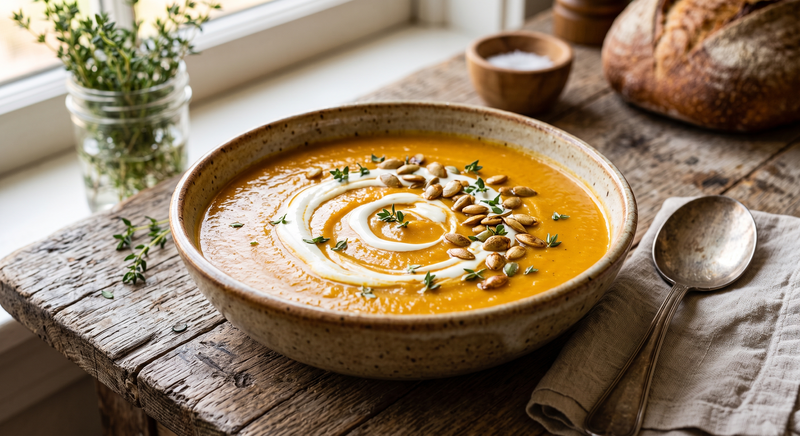
Butternut squash soup can be silky, sweet, and deeply savory, or it can taste like warm baby food. The difference is almost entirely in how the squash is cooked. Boiling cubes of squash in broth produces a mild, watery flavor, while roasting them first browns the edges and concentrates their natural sweetness. This recipe roasts the squash with onion and garlic, simmers everything briefly in broth, and blends it smooth. A splash of vinegar at the end keeps it from tasting heavy. Below you’ll find the reasoning behind each step, fixes for common problems, dairy-free options, and freezing advice.
Why this recipe works
Three choices do most of the work. First, roasting at a high temperature on a sheet pan dries the surface of the squash so it browns instead of steaming, the same principle we describe in flavor and color in cooking. Second, a tart apple adds a little acidity and freshness that plain squash lacks. Third, the soup is finished with acid and seasoned at the end, because roasted vegetables taste flat until you adjust the salt and add something bright. Blending does the rest, so you get a creamy texture without needing much cream at all.
Ingredients
Serves 4–6 (about 7 cups)
- 1 large butternut squash (about 3 pounds / 1.4 kg), peeled, seeded, and cut into 1-inch (2.5 cm) cubes, roughly 6 cups
- 1 large yellow onion, cut into 8 wedges
- 1 medium tart apple, such as Granny Smith, peeled, cored, and cut into large chunks
- 2 tablespoons olive oil, plus more to drizzle
- 1 teaspoon fine salt, divided, plus more to taste
- 4 cloves garlic, left unpeeled
- ½ teaspoon dried thyme, or 2 teaspoons fresh thyme leaves
- 4 cups (960 ml) low-sodium vegetable or chicken broth
- ⅓ cup (80 ml) heavy cream, half-and-half, or full-fat coconut milk (optional)
- 1–2 teaspoons apple cider vinegar or lemon juice
- Black pepper, to taste
- Toppings: toasted pumpkin seeds, a swirl of plain yogurt, a drizzle of olive oil, or crisped sage leaves
Ingredient notes
- Squash: Choose one that feels heavy for its size, with a dull, matte skin and no soft spots. Pre-cubed squash saves a lot of time and works fine, as long as the pieces are roughly the same size.
- Apple: It melts into the soup and isn’t meant to taste distinctly of apple. Leave it out if you prefer, and add a little extra vinegar at the end.
- Broth: Use low-sodium, because the soup is seasoned at the end and the flavor concentrates as it simmers.
- Garlic: Roasting the cloves in their skins keeps them soft and sweet instead of sharp or burnt.
How to make it
- Prep the squash. Trim both ends and cut the neck away from the rounded bulb, which gives you two stable pieces. Peel with a sturdy vegetable peeler, scoop out the seeds from the bulb, and cut everything into even 1-inch cubes. Even pieces roast at the same speed.
- Roast. Heat the oven to 425°F (220°C). Toss the squash, onion, and apple with the 2 tablespoons of oil and ¾ teaspoon of the salt. Spread across two sheet pans in a single layer, with a little space between pieces. Crowding traps steam and leaves the squash pale. Roast for 10 minutes, tuck the garlic cloves in among the vegetables, and continue roasting for 20–25 minutes more, stirring once, until the squash is fork-tender with browned edges.
- Simmer. Squeeze the roasted garlic from its skins into a large pot, and add the roasted vegetables, thyme, and broth. Bring to a simmer over medium heat and cook for 10 minutes, so the flavors combine.
- Blend. Blend until completely smooth with an immersion blender. If you’re using a countertop blender, work in batches and fill it no more than halfway. Remove the center cap from the lid, and cover the opening with a folded towel so steam can escape. Hot liquid can push the lid off a sealed blender.
- Finish. Return the soup to the pot over low heat. Stir in the cream if using, then add the vinegar a teaspoon at a time. Taste, and add salt and pepper until the sweetness is balanced by salt and a little acidity. Serve hot with toppings.
How to know it’s done
The squash is ready to leave the oven when a fork slides in with no resistance and the edges are visibly golden brown. Pale, soft squash will still make soup, but it will taste less sweet. After blending, the soup should be smooth and thick enough to coat the back of a spoon, with a slow ribbon when you lift it. If you reheat it later, bring it to 165°F (74°C), which an instant-read thermometer confirms in seconds.
Troubleshooting
- Bland or flat: It almost always needs more salt or acid rather than more spice. Add salt a pinch at a time, then more vinegar, tasting between each.
- Too thin: Simmer it uncovered for 5–10 minutes, stirring, to reduce it. Next time, use 3½ cups of broth instead of 4.
- Too thick: Whisk in warm broth or water a few tablespoons at a time. It thickens as it stands, so a slightly loose soup is a good sign.
- Stringy or fibrous: The squash may have been large or old, or the soup wasn’t blended long enough. Blend for another minute or two, or pass it through a fine strainer.
- Bitter or acrid taste: Some pieces, or the garlic, probably roasted too dark. Roast until golden brown, not dark brown, and use a slightly lower temperature if your oven runs hot.
- Pale and watery-tasting: The pans were crowded, so the squash steamed. Use two pans, or roast in two batches.
Variations and substitutions
These are suggestions rather than tested guarantees.
| Change | How to do it | What changes |
|---|---|---|
| Curry-ginger | Add 1 tablespoon mild curry powder and 2 teaspoons grated fresh ginger to the pot with the broth, and use coconut milk | Warmer, more aromatic soup |
| Smoky | Add ½ teaspoon smoked paprika before roasting, and finish with a pinch of chipotle powder | Earthy heat; start small and taste |
| Dairy-free | Use vegetable broth and coconut milk, or skip the cream entirely | Coconut adds a slight flavor; the soup is still creamy without it |
| Different squash | Use kabocha or sweet potato, cut to the same size | Sweet potato is denser and may need a few extra minutes; kabocha is drier and sweeter |
| Heavy cream | Whole milk, or plain yogurt stirred in off the heat | Lighter soup; heat gently after adding dairy so it doesn’t curdle |
| Apple | Ripe pear, or omit and use extra vinegar | Slightly sweeter with pear |
Serving suggestions
This soup is rich and slightly sweet, so pair it with something crisp, salty, or sharp. Toasted pumpkin seeds add crunch. A grilled cheese sandwich with sharp cheddar is a classic partner, and crusty bread suits the thick texture. A green salad with lemon vinaigrette balances the richness, and a spoonful of plain yogurt or a few drops of chili oil add contrast. In small cups, it makes an easy make-ahead starter for a holiday meal. For a heartier meal-in-a-bowl soup, our lentil and vegetable soup is a good companion.
Storage and reheating
Cool the soup and refrigerate it within 2 hours, in shallow containers so it cools quickly. It keeps for 3–4 days. It also freezes well, for up to about 3 months. If you plan to freeze it, leave out the cream and add it after thawing, since dairy can separate. Thaw it in the refrigerator overnight. Reheat over medium-low heat, stirring, until it simmers and reaches 165°F (74°C). It thickens as it sits, so loosen it with a splash of broth or water. A fresh squeeze of lemon or a small pinch of salt revives the flavor. Portions of this soup are an easy addition to a meal prep routine.
Recipe card
Roasted Butternut Squash Soup
Prep time: 20 minutes | Cook time: 50 minutes | Total time: 1 hour 10 minutes | Servings: 4–6 (about 7 cups)
Ingredients
- 1 large butternut squash (about 3 lb / 1.4 kg), peeled, seeded, cut into 1-inch cubes
- 1 large yellow onion, cut into 8 wedges
- 1 medium tart apple, peeled, cored, and chunked
- 2 tbsp olive oil, plus more to drizzle
- 1 tsp fine salt, divided, plus more to taste
- 4 garlic cloves, unpeeled
- ½ tsp dried thyme (or 2 tsp fresh)
- 4 cups (960 ml) low-sodium broth
- ⅓ cup (80 ml) heavy cream, half-and-half, or coconut milk (optional)
- 1–2 tsp apple cider vinegar or lemon juice
- Black pepper, to taste
Instructions
- Heat the oven to 425°F (220°C). Toss the squash, onion, and apple with the 2 tbsp oil and ¾ tsp salt. Spread over two sheet pans.
- Roast 10 minutes. Add the garlic cloves and roast 20–25 minutes more, stirring once, until the squash is fork-tender and browned at the edges.
- Squeeze the garlic from its skins into a large pot. Add the roasted vegetables, thyme, and broth. Simmer 10 minutes.
- Blend until smooth, in batches if using a countertop blender. Fill it no more than halfway, and vent the lid.
- Return to low heat. Stir in the cream if using. Add the vinegar a teaspoon at a time, then season with salt and pepper.
- Serve hot with your choice of toppings.
Notes
Use two pans so the squash browns instead of steaming. Reheat leftovers to 165°F (74°C). Roasting times vary with the size of the cubes and your oven.
FAQ
Can I make it ahead?
Yes. The soup tastes even better after a day in the refrigerator, once the flavors have settled. Reheat it gently and adjust the salt and vinegar just before serving.
Do I have to peel the squash?
For the smoothest soup, yes. Peeling is the most time-consuming step, so buying pre-cut squash is a reasonable shortcut.
Can I use an immersion blender?
Yes, and it’s the easiest option because you blend directly in the pot, with no transferring of hot soup. Keep the blade submerged to avoid splattering.
Can I make it without cream?
Yes. Roasted squash blends into a creamy texture on its own. A little olive oil or coconut milk adds richness if you want it.
Conclusion
The best butternut squash soup depends on a few habits: cut the squash evenly, roast it until browned instead of just softened, blend it thoroughly, and season at the end with salt and a little acid. Once you’ve made it as written, try the curry-ginger or smoky variation, or swap in another squash. It’s an easy pot of soup to make in a large batch and enjoy through the week.