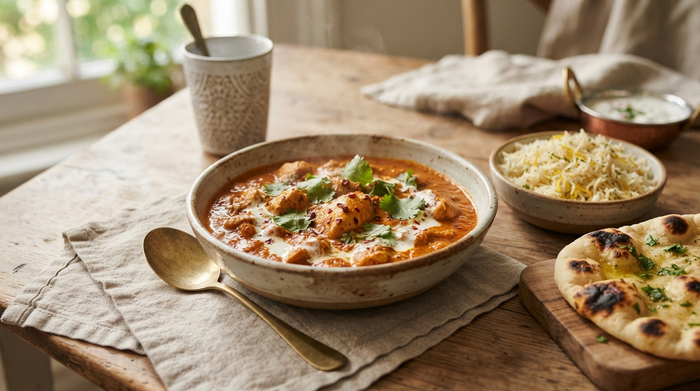
By Harry Cruse | TasteSavory
If your homemade curry tastes like lightly spiced water, you’re in good company. The usual problem isn’t a missing secret ingredient but a few steps that get rushed: cooking the base, heating the spices in fat, and seasoning at the end. This guide explains why curry can taste flat, covers seven fixes that work for Indian-style dishes, notes how Thai-style curries differ, and gives a flexible chicken or vegetable curry recipe with timings. One note first: “curry” is a broad English word covering many dishes with their own names and regional methods, so treat this as general technique, not the final word on any one tradition.
The short answer
- Cook the onion-tomato base much longer than feels natural, until it’s jammy and the oil visibly separates.
- Heat whole and ground spices in enough hot fat, briefly, and don’t let them burn.
- Season in layers: salt early, then add acid, a pinch of sugar if needed, and finishing spices at the end.
- Don’t drown the pot. Too much liquid for the spices gives a thin, watery taste.
What “flat” actually means
| What you taste | Likely cause | Fix |
|---|---|---|
| Sharp, raw, or “green” | Onions, tomatoes, ginger, or garlic weren’t cooked long enough | Cook the base until jammy and the oil separates |
| Watery or thin | Too much liquid, too few spices or aromatics | Simmer uncovered, and use less water next time |
| Dull, muted | Not enough salt or acid | Add salt, then lemon juice, tamarind, or a little vinegar |
| One-note or dusty | Spices stirred in raw, or only curry powder | Bloom spices in fat; add a finishing spice |
| Bitter or acrid | Burned garlic or spices | Use lower heat and add garlic and powders more briefly |
| Sour or harsh | Tart tomatoes or too much spice | Add a pinch of sugar, or stir in yogurt or coconut milk |
Seven fixes for Indian-style curries
1. Cook the base longer
This is the most common mistake. In many Indian-style dishes, the sauce starts with onions, ginger, garlic, and tomatoes cooked down until their raw flavor is gone. Cook the onions over medium heat, stirring, for roughly 10 to 15 minutes until golden, not just soft; our guide to caramelized onions explains the stages. After the tomatoes go in, keep cooking, often another 10 to 15 minutes, until the mixture is thick and jammy and a little oil shows at the edges. That oil is a sign the base is done, not a problem.
2. Bloom the spices in enough fat
Heating spices in oil or ghee wakes up their flavor and carries it through the dish. Whole spices such as cumin seeds usually need about 30 seconds until they sizzle and smell toasty; ground spices need only 10 to 30 seconds and burn easily, so add a splash of water if the pan is dry. Many recipes use more fat than people expect, often 3 to 4 tablespoons for a pot serving four to six, so don’t skimp. See our guide to toasting and blooming spices for details.
3. Be thoughtful about curry powder
Curry powder is a ready-made blend, and its balance may not suit your dish. It isn’t wrong, but on its own it can taste flat. If you use it, bloom it in fat first. Better yet, build the flavor from individual spices such as cumin, coriander, turmeric, and chili, then add a small amount of garam masala at the end.
4. Use fresh ginger and garlic, and cook out the rawness
Raw ginger and garlic taste harsh. Cook them for a minute or two after the onions until fragrant, but keep the heat moderate so the garlic doesn’t turn bitter.
5. Season in layers
Salt early so it flavors the base, then taste at the end. Many “bland” curries just need more salt. A squeeze of lemon, a spoonful of tamarind, or a splash of vinegar adds brightness. A pinch of sugar can soften tart tomatoes.
6. Finish with a last layer of aroma
Finishing spices go in at the end, so their aroma stays fresh. Stir in a pinch of garam masala just before serving. Dried fenugreek leaves (kasuri methi) are a common finishing ingredient: crush them between your palms and add them in the last minute or two, because they’re strong and turn bitter if overdone. Fresh cilantro adds a final lift.
7. Use a suitable fat
Ghee or a neutral oil with a high smoke point works well for frying onions and spices. Extra-virgin olive oil has a flavor and smoke point that don’t suit this style.
How Thai-style curries differ
Thai curries use a different method, so don’t mix the two. They’re built on a curry paste, and the key step is frying that paste in fat first. A traditional approach is to simmer the thick cream from the top of an unshaken can of coconut milk until the oil separates, then fry the paste in it for a couple of minutes until fragrant. Skipping this step can leave a raw, garlicky taste. Then add the remaining coconut milk and protein.
Balance is central: fish sauce for salt, palm sugar (or brown sugar) for sweetness, and lime for brightness, adjusted to taste. Crush kaffir lime leaves to release their aroma, and add Thai basil at the very end, since it wilts in seconds. A good-quality paste does a lot of the work.
Recipe: Everyday chicken or vegetable curry
Prep time: 15 minutes | Cook time: 50 minutes | Serves: 4 with rice or flatbread
Ingredients
- 3 tablespoons ghee or neutral oil
- 1 teaspoon cumin seeds
- 2 medium onions, finely chopped (about 2 cups)
- 1 tablespoon grated fresh ginger
- 4 cloves garlic, minced
- 1 to 2 green chilies, chopped, optional
- ½ teaspoon ground turmeric
- 1 teaspoon ground coriander
- 1 teaspoon ground cumin
- ½ to 1 teaspoon chili powder, to taste
- 1½ cups chopped ripe tomatoes, or one 14-ounce can crushed tomatoes
- 1 to 1¼ teaspoons salt, divided
- 1 pound (450 g) boneless chicken thighs, cut into pieces, or 4 cups vegetables such as cauliflower, potatoes, or chickpeas
- 1 cup water
- ½ teaspoon garam masala
- 1 teaspoon dried fenugreek leaves (kasuri methi), optional
- 1 to 2 teaspoons lemon juice, and chopped cilantro to finish
Instructions
- Bloom the cumin seeds. Heat the ghee in a wide, heavy pot over medium heat. Add the cumin seeds and cook for about 30 seconds, until they sizzle and smell toasty.
- Brown the onions. Add the onions and a pinch of salt. Cook, stirring often, for 12 to 15 minutes, until deep golden. If they stick, add a splash of water.
- Add the aromatics. Stir in the ginger, garlic, and chilies and cook for 1 to 2 minutes, until fragrant.
- Add the ground spices. Stir in the turmeric, coriander, cumin, and chili powder for 20 to 30 seconds. Add a splash of water if the pan looks dry.
- Cook down the tomatoes. Add the tomatoes and ½ teaspoon of the salt. Cook for 10 to 15 minutes, mashing, until thick and jammy and oil shows at the edges.
- Cook the main ingredient. Add the chicken or vegetables, stir to coat, and cook for 3 to 4 minutes. Add the water, cover, and simmer gently for 20 to 25 minutes, until the chicken reaches 165°F (74°C) and the vegetables are tender; see our thermometer guide.
- Finish. Stir in the garam masala, crush the fenugreek leaves over the pot, and add lemon juice. Taste and add more salt if needed. Top with cilantro.
Notes
- For a vegetable version, cauliflower and chickpeas work well; see our cauliflower guide.
- The onion and tomato base can be made ahead and refrigerated for about a week, or frozen for longer.
- For a hands-off alternative, see the slow-cooker curry idea in our dinner ideas roundup.
Rescue a curry that’s already cooked
- Simmer it uncovered for 10 to 15 minutes to thicken and concentrate the flavor.
- Add a quick tadka: Heat a tablespoon of ghee, add cumin seeds or dried chilies for a few seconds, and pour it over the finished curry.
- Adjust the seasoning: Add salt first, then lemon, a pinch of sugar, or garam masala.
- Soften harshness with a spoonful of yogurt or coconut milk. For other flat dishes, see our guide to fixing bland soup.
How to practice
Vegetable curries are a good place to start, because the spicing and seasoning have to carry the dish without meat. Cook the same base a few times, change one thing at a time, and taste often. Over time you’ll recognize when the onions are ready and the oil has separated, which no recipe can fully teach.
FAQ
Is curry powder okay to use?
It can work, especially when bloomed in fat and combined with other flavors, but it can taste flat on its own. Individual spices give you more control.
Why does oil float on top of my curry?
That’s usually a sign the base was cooked well. It’s expected in many Indian-style curries.
Can I make the base ahead?
Yes. Refrigerate it for about a week, or freeze it in portions, then add your protein and liquid when you’re ready.
How long do leftovers keep?
Refrigerate within 2 hours and use within 3 to 4 days, as outlined in our storage guidance.
Conclusion
A flat curry is rarely a failure of ingredients. It’s usually a base that needed more time, spices that needed hot fat, or a dish that needed a final round of salt, acid, and aroma. Cook the base until the oil separates, bloom your spices without burning them, finish with something fragrant, and taste as you go. After a couple of tries, your curry will taste much more like the ones you’ve been aiming for.