By Harry Cruse | TasteSavory
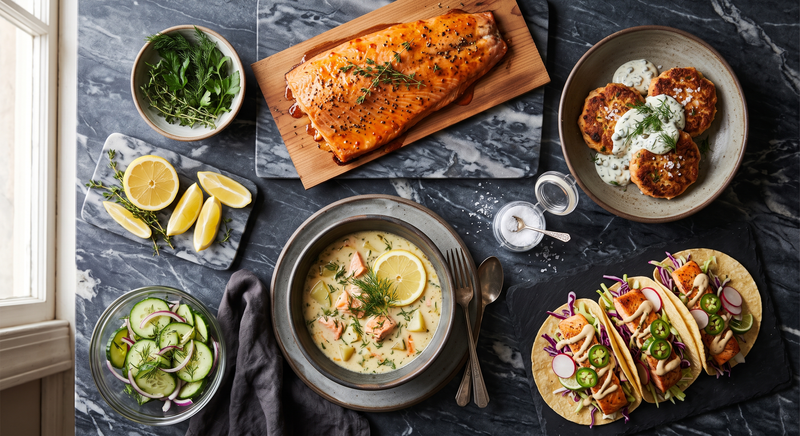
Salmon is a great fish to have too much of, and a surprisingly hard one to keep interesting. It’s rich and fatty, so heavy cream sauces can make it feel like too much. Cook it the same way a few nights in a row, and even a beautiful fillet gets tiresome. Cooks who’ve faced a freezer full of salmon, whether from a good fishing trip or a sale at the store, tend to reach for the same solutions: bright, acidic flavors; a sweet-tart glaze; fresh herbs; a different format such as cakes or soup; and ways to preserve the surplus. This guide collects twenty of those ideas, with two recipes (a cedar plank salmon with an orange-pepper glaze, and salmon cakes with a caper-dill sauce), a company-worthy menu, and clear food-safety guidance for freezing, curing, and smoking fish.
The short answer
- Rich salmon is balanced by acid (lemon, vinegar, citrus), freshness (herbs, cucumber, salsa), and a little sweetness or heat, not by more fat.
- Cook it to 145°F (63°C), which is the USDA’s recommended minimum, and don’t overcook it.
- If you have a lot, change the format: cakes, burgers, soup, salads, tacos, or pasta.
- Freeze what you can’t use quickly, and follow tested guidance for curing, smoking, and canning.
- If you plan to eat any fish raw or lightly cured, the freezing and handling rules are stricter, and they are explained below.
Why rich fish needs balance
Fatty salmon is delicious precisely because it’s rich, and the best accompaniments cut through that richness instead of adding to it. Acid brightens it, herbs and raw vegetables add freshness, and a bit of sweetness or heat gives contrast. This is the same principle we describe in flavor and color in cooking. For a quick way to apply it, the lemon-Dijon vinaigrette, garlic-yogurt sauce, and chimichurri in our essential sauces all suit salmon well.
Flavor directions beyond the usual
If you’re tired of one flavor family, there are plenty of others. “Asian” covers a vast range of cuisines, but if your household wants a break from soy and ginger, these directions are all different.
| Direction | Typical flavors | Try it with |
|---|---|---|
| Nordic | Dill, mustard, horseradish, cucumber, potatoes, lemon | Poached or baked salmon, gravlax, soups |
| Mediterranean | Lemon, capers, olives, tomato, herbs, garlic | Foil packets, roasted salmon, pasta |
| Cajun and Southern | Blackening spices, brown sugar, hot sauce, grits or polenta | Pan-seared or grilled salmon |
| Latin American | Chimichurri, salsa verde, mango salsa, lime, chiles | Grilled salmon, tacos |
| Middle Eastern and North African | Za’atar, sumac, harissa, chermoula, yogurt | Roasted or pan-seared salmon |
| Caribbean | Jerk seasoning, lime, mango, allspice | Grilled or air-fried salmon |
| North American | Maple, brown sugar, mustard, cedar smoke | Plank-grilled salmon |
Twenty ideas
Eight ways to cook a fillet
- Cedar plank. Smoky, gentle, and impressive for company. See the recipe below.
- Foil or parchment packet (en papillote). Seal the fish with lemon slices, onion, herbs, a little butter or wine, and a thin layer of vegetables, and bake or grill for roughly 15–20 minutes. It steams in its own juices, which keeps it moist and light.
- Blackened or Cajun. Coat with a spice blend and sear in a hot pan or grill. A pinch of sugar helps the crust, and the heat offsets the richness. Serve with lemon and polenta.
- Spice-rubbed. Harissa, jerk, za’atar, sumac, smoked paprika, or a brown sugar and pepper rub all work. Our guide to toasting and blooming spices explains how to bring out more flavor.
- Sweet-tart glazes. Maple and Dijon, orange and black pepper, balsamic, apricot with horseradish, or a berry-balsamic reduction. Add them near the end of cooking, because sugar burns. See sweet and salty foods.
- Herb-panko or nut crust. Press a mix of breadcrumbs, lemon zest, herbs, and a little Parmesan or crushed nuts onto a thin coat of mustard or mayonnaise, and bake on a rack.
- Poached or steamed. Gentle cooking in broth or water with aromatics gives tender, mild fish that works for salads and sandwiches.
- Pan-seared or air-fried. Quick and crisp-skinned. Pat the skin dry, start skin-side down in a hot pan, and press gently so it stays flat.
Five bright toppings and sides that cut the richness
- Mango or pineapple salsa. Sweet, tangy, and fresh, with red onion, lime, cilantro, and a little chile.
- Chimichurri, salsa verde, or gremolata. Herb-and-acid sauces that you drizzle on after cooking.
- Dill-yogurt or mustard-dill sauce. Cool, tangy, and lighter than cream. Serve it on the side so everyone controls how much to use.
- Lemon-caper sauce. The briny tang of capers cuts the fat. A little butter is enough.
- Cucumber salad and pickled onions. Thinly sliced cucumber with salt, vinegar, a little sugar, and dill, or quick-pickled red onion. Our cauliflower guide has roasted side ideas that pair well.
Five dishes beyond the fillet
- Salmon cakes or patties. A good use for leftovers or poached salmon, served with an acidic sauce. See the recipe below.
- Salmon burgers. Chop the fish by hand or pulse it briefly in a food processor, and bind it lightly with egg, panko, and herbs. Our burger guide has tips on handling and shaping patties.
- Salmon soup or chowder. Finnish-style salmon soup is brothy and light, with leeks, potatoes, dill, and a little cream. If it needs more flavor, see how to fix bland soup, and for texture, how to thicken soup.
- Salads and bowls. Salmon nicoise, salmon Caesar, or a grain bowl with cooked salmon served warm or chilled.
- Tacos, pasta, and quesadillas. Flake the fish into tacos with lime slaw, toss it with pasta and a lemon-caper sauce, or fold it into a quesadilla with cheese.
Two ways to preserve a surplus
- Freeze it. The simplest way to keep a lot of salmon. See the storage section below.
- Cure, smoke, or can it. Gravlax, hot-smoked salmon, salmon candy, and canned salmon are traditional ways to preserve it, and each has specific safety rules, covered below.
Recipe 1: Cedar plank salmon with orange-pepper glaze
Prep time: 15 minutes, plus soaking the plank | Cook time: 15–25 minutes | Serves: 4–6
Ingredients
- 1 untreated cedar grilling plank, soaked in water for at least 1 hour (longer is fine)
- 2 pounds (900 g) skin-on salmon fillet, about 1 inch thick, pin bones removed
- ¾ teaspoon kosher salt and ½ teaspoon black pepper
- ½ cup (120 ml) orange juice
- 1 tablespoon honey or maple syrup
- 1 teaspoon Dijon mustard
- 1 teaspoon finely grated orange zest
- ½ teaspoon coarsely ground black pepper
- Orange slices and fresh thyme or dill, to serve
Instructions
- Make the glaze. Simmer the orange juice, honey, mustard, zest, and coarse pepper in a small saucepan over medium heat for 6–8 minutes, until reduced to about ¼ cup and syrupy. Let it cool slightly.
- Heat the grill. Heat a grill to medium (around 375°F / 190°C). Place the soaked plank on the grates, close the lid, and heat for 3–5 minutes, until the plank starts to smoke and crackle. Turn the plank over.
- Cook. Pat the salmon dry, season with the salt and pepper, and set it skin-side down on the heated plank. Brush with a little glaze. Close the lid and cook for 15–25 minutes, until the thickest part reaches 145°F (63°C), brushing with more glaze in the last 5 minutes.
- Rest and serve. Move the plank to a heatproof surface, rest the fish for 3–5 minutes, and serve it from the plank with orange slices and herbs.
Notes: Keep a spray bottle of water nearby to tame flare-ups, never leave a plank on the grill unattended, and follow the fire and gas precautions in our outdoor kitchen guide. For an oven version, set the soaked plank on a baking sheet and cook at 400°F (200°C) for about 15–25 minutes. Check with an instant-read thermometer early, because thickness varies.
Recipe 2: Salmon cakes with caper-dill yogurt sauce
Prep time: 20 minutes, plus chilling | Cook time: 8 minutes | Makes: 6 cakes
Ingredients
- 1 pound (450 g) cooked salmon, flaked (about 2 cups), from poached, steamed, or leftover baked salmon
- 1 large egg
- ½ cup (30 g) panko breadcrumbs, plus more if needed
- 2 tablespoons mayonnaise
- 1 tablespoon Dijon mustard
- 2 scallions, thinly sliced
- 1 tablespoon chopped fresh dill or parsley
- 1 teaspoon lemon zest
- ½ teaspoon salt and ¼ teaspoon black pepper
- 2–3 tablespoons neutral oil, for pan-frying
Sauce: ½ cup (120 g) plain Greek yogurt, 1 tablespoon chopped capers, 1 tablespoon chopped dill, 1 tablespoon lemon juice, and a pinch of salt.
Instructions
- Gently mix the salmon, egg, panko, mayonnaise, mustard, scallions, dill, zest, salt, and pepper. If the mixture seems loose, add more panko a tablespoon at a time.
- Shape into 6 patties about ¾ inch thick. Chill for 20–30 minutes, which helps them hold together.
- Heat the oil in a skillet over medium heat. Cook the cakes for 3–4 minutes per side, until golden and the centers reach 165°F (74°C).
- Stir the sauce ingredients together and serve with the cakes and lemon wedges.
Notes: Handle the mixture gently so the cakes stay tender. Serve on greens, in a bun, or with polenta.
A company-worthy menu
| Course | Idea |
|---|---|
| Starter | A light broth or carrot-ginger soup in small cups. See our light soup starters |
| Main | Cedar plank salmon with orange-pepper glaze, with a dill-yogurt sauce on the side |
| Sides | Wild rice, roasted cauliflower, and a cucumber-dill salad |
| Dessert | A lemon tart or a fruit-based dessert |
Our sheet-pan lemon-herb salmon is a simpler option if you’re cooking for a crowd without a grill.
Cooking salmon so it stays moist
- Use a thermometer. The USDA recommends 145°F (63°C) for fish. Some cooks prefer salmon less cooked, which is a personal choice and carries somewhat more risk, particularly for children, pregnant women, older adults, and anyone with a weakened immune system.
- Start with even thickness. Thin tail pieces cook faster than thick centers, so cut fillets into evenly sized portions.
- Don’t overcook. Salmon continues to cook after it leaves the heat, so take it off as it reaches the target.
- Salt ahead. A little salt for 15 minutes before cooking seasons the fish. A short brine also helps reduce the white protein (albumin) that seeps out of salmon, which is harmless but not pretty.
- Pat the skin dry. For crisp skin, start with a dry surface and a hot pan, as in our cooking habits guide.
If you caught the fish yourself
Gut and chill the fish as soon as possible, and keep it on ice or at 40°F (4°C) or below until you cook or freeze it. Cook it within a day or two of catching it, or freeze it. It’s also worth checking your state or local fish consumption advisories, which can give guidance on how often certain waters’ fish are best eaten.
Freezing, curing, smoking, and canning safely
Freezing
Portion the fish into meal-sized pieces, remove as much air as possible, and wrap tightly or vacuum-seal. Label with the date, and freeze for best quality within a few months. Thaw in the refrigerator, and cook within 1–2 days. Many food-safety authorities advise taking vacuum-packed frozen fish out of its package before thawing, because low-oxygen packaging can allow certain bacteria to grow. Don’t thaw on the counter. See our guide to storing food in the kitchen and our meal prep guide.
Raw, cured, and lightly cooked salmon
Fish eaten raw or only lightly cured, such as sashimi, ceviche, and gravlax, carries a parasite risk, especially in wild-caught fish. The FDA guidance for commercial fish intended for raw consumption is to freeze and store it at -4°F (-20°C) or below for 7 days, or at -31°F (-35°C) until solid and for 15 hours more, among other combinations. Many home freezers hold only 0°F (-18°C), which is warmer than the guidance, so home-frozen fish isn’t a reliable substitute for fish that was commercially frozen for raw use. Salting, brining, and pickling do not reliably remove the parasite hazard. If you want to cure salmon, use fish that was frozen to the recommended conditions, follow a tested recipe, and know that cured and cold-smoked fish can also carry Listeria, which is a particular concern for pregnant women, older adults, and people with weakened immune systems. They are generally advised to avoid it.
Smoking
Hot-smoked salmon is cooked as it smokes. Food-safety guidance for hot smoking generally calls for the fish to reach a minimum internal temperature and hold it for at least 30 minutes, with figures of 145°F (63°C) in some guidance and 160°F (71°C) in some university extension materials. Use a thermometer, follow a tested recipe from a university extension service or similar source, refrigerate smoked fish promptly, and be careful with vacuum packaging, since smoked fish stored in low-oxygen packaging for long periods carries a risk of botulism.
Canning
Fish is a low-acid food, so it must be pressure canned, never water-bath canned, and only with a tested recipe from a reliable source such as a university extension service or the National Center for Home Food Preservation. Don’t improvise the jars, the time, or the pressure.
Candied salmon and jerky
Salmon candy and salmon jerky are popular uses for a surplus, but they involve curing, smoking, and drying, so they come with the same cautions. Use a tested recipe, keep the fish cold throughout, and store the finished product in the freezer or refrigerator as the recipe directs.
Troubleshooting
- Dry salmon: It’s overcooked. Use a thermometer, take it off the heat at the target, and choose thicker, evenly cut pieces.
- Too rich: Add acid and fresh elements, such as lemon, a vinegar-based sauce, pickles, or a salad, and serve smaller portions.
- Fishy smell or taste: The fish may not be fresh. Fresh salmon smells mild. Discard fish with a strong sour or ammonia smell.
- White stuff oozing out: It’s albumin, a harmless protein. Cook more gently, and consider a short salt brine next time.
- Glaze burns: It went on too early. Brush it on during the final 5 minutes.
- Cakes fall apart: The mixture was too wet or wasn’t chilled. Add panko and chill the patties.
FAQ
What is the best way to cook salmon for a crowd?
Roasting a whole side on a sheet pan, or cooking it on a plank, serves many people at once with little work. Cook it to 145°F (63°C).
How do I make salmon taste less rich?
Serve it with acidic, fresh flavors, such as lemon, vinegar-based sauces, salsa, pickled vegetables, or a crisp salad. Avoid adding heavy cream-based sauces.
How long does cooked salmon keep?
Refrigerate within 2 hours, and eat within 3–4 days. It can be flaked into salads, sandwiches, and cakes.
Is it safe to eat salmon raw?
Only if it has been handled and frozen appropriately for raw use. If you’re unsure, cook it. Pregnant women, young children, older adults, and anyone with a weakened immune system should avoid raw fish.
Conclusion
A lot of salmon is a gift, and the best way to enjoy it is variety. Balance its richness with acid, herbs, and fresh sides. Cook it to the right temperature, and change the format with cakes, soup, salads, and tacos. Freeze the surplus, and treat curing, smoking, and canning with the care they require. Start with a plank or a simple foil packet this week, and keep a second idea ready for the next night.