By Harry Cruse | TasteSavory
A soup before the main meal is an old holiday tradition in many families, and it comes with a real design problem. Thanksgiving dinner is already heavy, with turkey, stuffing, mashed potatoes, gravy, and several other sides. A thick, creamy starter can leave guests half full before the plates come out. Cooks who regularly serve a first-course soup tend to follow the same rules: keep it small, keep it light, don’t repeat what’s coming next, and make it ahead so it doesn’t compete for stove space on the day. This guide offers twelve soup ideas that fit those rules, explains how to lighten any soup, covers serving sizes and make-ahead timing, and includes two recipes. It works for any large holiday dinner, not just Thanksgiving.
The short answer
- Choose a soup that’s lighter than the main meal: brothy, bright, or a lightly blended vegetable purée.
- Avoid repeating the menu. If you’re serving mashed potatoes and squash, skip potato and squash soups.
- Serve small portions, about ½ to ¾ cup, in cups, mugs, or small bowls.
- Make it ahead, and keep it hot at 140°F (60°C) or above until serving.
- Always have a plan for guests with allergies or dietary needs, especially with shellfish and dairy.
Should you serve a soup at all?
It depends on your crowd. Some hosts feel a starter is unnecessary on a day when the table already holds a dozen dishes, and some guests would rather save their appetite. Others say soup is the favorite part of the meal and would rather skip the turkey than skip the soup. A good compromise is a small, light starter served in demitasse cups, mugs, or shot glasses, which gives everyone a warm start without filling them up. If you’re short on stove space or time, an easy cold appetizer, such as shrimp cocktail, is a perfectly good alternative. The best choice is the one that fits your menu, your kitchen, and your guests.
How to choose the right soup
- Go lighter than the meal. Clear broths and thin purées whet the appetite, while thick chowders and bisques can overshadow the main course.
- Offer contrast. A bright, tangy, or spiced soup stands out against savory sage-flavored sides. A touch of acid, such as lemon or vinegar, keeps it fresh, as described in flavor and color in cooking.
- Don’t double up. If the menu already includes potatoes, squash, or sweet potatoes, pick a different base for the soup.
- Think about make-ahead. Most soups improve after a day in the refrigerator, and they free up your oven and stove on the day.
- Ask about diets and allergies. Plant-based broth, dairy-free purées, and soups without shellfish are the safest choices for a mixed group.
Twelve soup ideas
| Soup | Why it works | How to keep it light | Make-ahead |
|---|---|---|---|
| Butternut squash or pumpkin | Seasonal and familiar, and many guests love it | Use broth and a splash of cream, or coconut milk. See our roasted butternut squash soup | Up to 3 days ahead |
| Carrot-ginger | Sweet and zesty, and gentle after a big meal | Skip the cream, and add lemon at the end. Recipe below | Up to 3 days ahead |
| Clear broth or consommé | Intensely flavored but very light | It’s already light. Serve in small cups with a fine garnish | Up to 3 days ahead |
| French onion, lightened | Deep, savory, and elegant in small portions | Use a small crouton and a little cheese instead of a heavy cap | Make the soup ahead, and broil the topping at serving |
| Italian wedding | Brothy, with small meatballs and greens | Keep the meatballs tiny, and use plenty of broth | Make the broth and meatballs ahead |
| Roasted red pepper | Sweet, smoky, and different from the rest of the menu | Blend with broth, and add cream sparingly | Up to 3 days ahead |
| Cauliflower | Blends creamy without much fat | Roast the cauliflower for flavor, and use broth | Up to 3 days ahead |
| Celery or asparagus | Delicate, fresh, and underrated | Use a small amount of cream, or none | Up to 2 days ahead |
| Beet and dill (borscht) | Bright, tangy, and colorful | Choose the clear version | Up to 3 days ahead |
| Tortilla soup | Broth with tomato, lime, and garnishes | Serve small, with the garnishes on the side | Make the broth ahead |
| Miso or hot and sour | Light, savory, and a departure from tradition | It’s already light | Best made the day of or the day before |
| Mushroom, in small cups | Earthy and savory | Use a brothy version, and serve in small portions. Recipe below | Up to 3 days ahead |
Some soups on many lists need extra care. Potato and leek is a classic, but it’s starchy, and heavy cream-based chowders and bisques can fill guests up quickly. Oyster stew is a long-standing holiday tradition in some regions, but oysters are a polarizing ingredient and a shellfish allergen, so offer an alternative if you serve it. A soup that’s loved by half the table and avoided by the other half rarely works as the only starter.
Ways to make any soup lighter
- Use broth in place of cream. Blended vegetables supply creaminess on their own. If you use cream, add only a few tablespoons.
- Roast the vegetables first. Roasting adds depth, so you don’t need heavy ingredients for flavor.
- Finish with acid. A squeeze of lemon, a splash of vinegar, or a dollop of yogurt brightens the soup and makes it taste lighter.
- Season carefully. A soup that tastes bold in a small cup holds up against the rest of the meal.
- Keep the garnishes light. Herbs, a few toasted seeds, a drizzle of olive oil, or a few small croutons add texture without weight.
- Serve less. A smaller portion is the easiest way to keep a soup light.
Recipe 1: Light carrot-ginger soup
Prep time: 15 minutes | Cook time: 35 minutes | Serves: 8 as a small starter (about ¾ cup each) or 4–5 as a bowl
Ingredients
- 2 tablespoons olive oil or butter
- 1 medium onion, chopped
- 1½ tablespoons peeled, grated fresh ginger
- 2 cloves garlic, minced
- 1½ pounds (680 g) carrots, peeled and sliced about ½ inch thick
- 4 cups (960 ml) low-sodium vegetable or chicken broth
- ½ teaspoon fine salt, plus more to taste
- 1–2 teaspoons lemon juice
- 2–3 tablespoons cream or coconut milk (optional)
- Chopped chives or toasted pumpkin seeds, to garnish
Instructions
- Heat the oil in a large pot over medium heat. Cook the onion for 5 minutes, until soft. Add the ginger and garlic and cook for 1 minute, until fragrant.
- Add the carrots, broth, and salt. Bring to a boil, then reduce the heat and simmer, partially covered, for 25–30 minutes, until the carrots are very tender.
- Blend until completely smooth. An immersion blender is easiest, as described in our essential kitchen tools guide. If you use a countertop blender, work in batches, fill it no more than halfway, and vent the lid so the steam can escape.
- Return the soup to the pot. Stir in the lemon juice and the cream, if using. Taste, and adjust the salt and lemon. If it’s too thick, add a splash of broth.
- Serve hot in small cups, topped with chives or pumpkin seeds.
Notes: For a thicker soup, add a small parsnip or potato with the carrots, though that adds starch. If it’s too thin, simmer it uncovered for a few minutes, or see our guide to thickening soup. A curry powder or warm spice added with the ginger gives it a different character, and our guide to toasting and blooming spices explains how.
Recipe 2: Lemon-herb mushroom broth
Prep time: 10 minutes | Cook time: 25 minutes | Serves: 6 (about 1 cup each)
Ingredients
- 1 tablespoon butter or olive oil
- 8 ounces (225 g) mushrooms, thinly sliced
- 6 cups (1.4 liters) low-sodium chicken or vegetable broth
- 2 sprigs fresh thyme
- 1 small carrot, cut into thin rounds
- 1 celery stalk, thinly sliced
- 1 tablespoon lemon juice, or 2 teaspoons sherry vinegar
- Salt and black pepper, to taste
- Chopped parsley or chives, to finish
Instructions
- Heat the butter in a large pot over medium-high heat. Add the mushrooms in a single layer, working in two batches if needed, and cook for 5–7 minutes without stirring too often, until they’re browned. Browning is where much of the flavor comes from.
- Pour in the broth, add the thyme, and bring to a simmer.
- Add the carrot and celery and simmer gently for 8–10 minutes, until just tender.
- Remove the thyme stems. Stir in the lemon juice, then season with salt and pepper.
- Serve hot in small cups, with the herbs on top.
Notes: The quality of the broth matters, because there’s little else in the pot. A good homemade or high-quality stock makes a noticeable difference. Skimming any foam from the surface gives a cleaner look and taste. A small spoonful of cooked rice or tiny pasta turns it into a more filling soup if you want one.
Serving and portion ideas
- Portion size: A common guideline for a starter is about ½ to ¾ cup per guest, which is a small mug or cup. For eight guests, plan on 4–6 cups of soup.
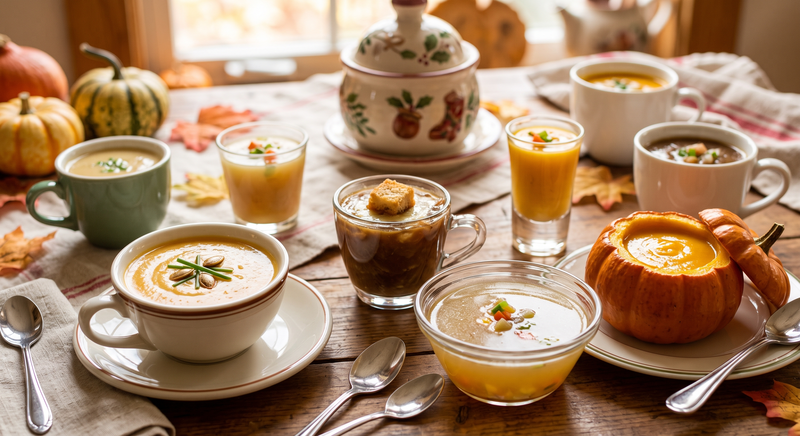
- Serve in small vessels: Demitasse cups, espresso cups, small mugs, or shot glasses suit purées. Serve them with the appetizers, or pass them at the table.
- Pre-warm the cups: A little hot water in the cups before serving keeps the soup hot longer.
- Time it: Serve the soup about 15–20 minutes before the main meal, while the turkey rests.
- Use a pumpkin or squash bowl: Roasted mini pumpkins make a pretty serving vessel. Roast the empty shell separately and fill it with finished soup, as we recommend in our guide to soup in a pumpkin.
A make-ahead plan
- Two to three days before: Choose the soup, shop, and make the broth or purée. Cool it quickly in shallow containers, and refrigerate.
- The day before: Prepare the garnishes, such as croutons, toasted seeds, and chopped herbs. If you’re using a dairy swirl, add it on the day.
- The day of: Reheat the soup gently on the stove or in a slow cooker. Bring it to a simmer, adjust the seasoning, and keep it hot.
- At serving: Ladle into warmed cups, garnish, and serve.
For the rest of the menu, our holiday meal ideas include a full make-ahead timeline and portion guidelines.
Food safety and allergies
- Keep it hot. Hold soup at 140°F (60°C) or above in a slow cooker on warm, or in a pot over very low heat. Don’t leave it sitting out for more than 2 hours.
- Cool it fast. Divide make-ahead soup into shallow containers and refrigerate within 2 hours. Use it within 3–4 days.
- Reheat thoroughly. Bring soup to a rolling boil, or at least 165°F (74°C), before serving. See our thermometer guide.
- Be careful with blended hot soup. Hot liquid can push the lid off a sealed blender. Use an immersion blender, or vent the lid and cover it with a towel.
- Plan for allergies. Ask guests about shellfish, dairy, nuts, and gluten, and label what’s in each soup. Use vegetable broth and skip the cream for vegetarian or dairy-free guests.
- Freezing: Most puréed soups freeze well for a couple of months. Leave out the cream, and add it after thawing. See our guide to storing food in the kitchen.
Troubleshooting
- The soup is too thick: Stir in warm broth a few tablespoons at a time. Soups thicken as they sit.
- It tastes flat: It needs salt first, then acid. Add them a little at a time and taste between additions.
- It’s too sweet: Carrot, squash, and pepper soups can turn sweet. Add lemon juice, vinegar, or a pinch of salt.
- It’s too heavy: Thin it with broth, and serve a smaller portion.
- The cream curdled: It was added to a boiling or very acidic soup. Add cream off the heat, and reheat gently.
FAQ
What’s the best soup to serve before Thanksgiving dinner?
Light, brothy, or thinly blended soups work best. Carrot-ginger, a clear broth, and lightened French onion are all reliable choices, and squash and pumpkin are popular if you aren’t serving them elsewhere on the menu.
How much soup do I need per person?
About ½ to ¾ cup for a starter. Plan for more if the soup is the main course of a lighter meal.
Can I make the soup a few days ahead?
Yes. Most soups keep for 3–4 days in the refrigerator, and many taste better after a day. Reheat until it’s very hot.
Should I skip the soup?
You can. If the menu is already large, a small cold appetizer is an easy alternative.
Conclusion
The best Thanksgiving soup is the one guests barely notice they’ve finished: warm, flavorful, and small enough to leave plenty of room for dinner. Choose something lighter than your main dishes, avoid repeating the sides, make it ahead, and keep it hot. Start with the carrot-ginger or the mushroom broth above, adjust the seasoning, and enjoy a calmer holiday kitchen.