By Harry Cruse | TasteSavory
Every fall, a cooking video makes the rounds: someone fills a pumpkin with vegetables, adds no liquid, seals the lid, and bakes it for a couple of hours. When it comes out of the oven, there’s supposedly a pot of soup inside. It looks magical, and it raises a fair question for anyone who loves soup but hates a thin, bland broth: does it actually work? Home cooks who’ve tried cooking in pumpkins offer a consistent answer, and so does basic food science. This guide explains what happens inside the pumpkin, where the “no-water” idea does work, what pumpkins are genuinely good for, and a safer way to get the same cozy result, including a stew recipe baked in a pumpkin with the liquid it needs.
The short answer
- A sealed pumpkin filled with solid ingredients and no liquid generally gives you a moist, stewed filling, not a pot of soup.
- Pumpkin is mostly water, but most of it stays locked in the flesh unless you blend or press it.
- “No-water soup” is a real technique, but it works with very watery vegetables and still produces only a modest amount of broth.
- If you cook in a pumpkin, add liquid, use an edible pumpkin, and bake it on a rimmed pan, because pumpkins soften, sag, and leak.
- Build flavor first by browning or sweating the ingredients, and season well. Raw ingredients in a sealed pumpkin taste bland.
What the trend claims
The trend combines two ideas. The first is “no-water soup,” in which you cook vegetables, and sometimes meat, in a covered pot without adding liquid, so the ingredients release their own juices. The second is cooking in a pumpkin, which acts as an edible pot. Put them together, and the claim is that the pumpkin’s moisture plus the ingredients’ juices turn into a full-bodied soup. In forum discussions of the trend, many experienced cooks were skeptical, and their reasoning is worth understanding.
Does it actually work?
Mostly no, for a handful of reasons.
- The water is locked in. Raw pumpkin is roughly 90 percent water, but that water is held inside the flesh. It doesn’t pour out like juice. As the pumpkin bakes, some of it is released, and some of it evaporates. The rest stays in the softened flesh, which is why a baked pumpkin tastes moist but doesn’t turn into soup. The flesh has to be blended or pressed to become a liquid.
- The volume doesn’t add up. Even a very watery filling, such as onions, cabbage, or tomatoes, gives off a modest amount of liquid, enough for a spoonful of sauce per serving, not a bowl of broth.
- Pumpkin isn’t a sealed pot. Once it softens, the walls sag and can split, so liquid can seep out onto the pan, not collect inside.
- Viral videos skip steps. Short cooking videos often don’t show everything. Some commenters suspected that liquid was added or that the finished shot was edited. I can’t say what happened in any particular video, but it’s a reasonable caution about “miracle” recipes.
One more point: if you do get a soupy result, it’s likely coming from the pumpkin flesh, which tastes mild and slightly sweet. A broth made from water-heavy ingredients can taste thin without enough salt, fat, and browned flavor, which is why a pot of seasoned stock usually tastes better.
Where “no-water” cooking does work
Waterless soup is a real technique. The idea is to cook very juicy vegetables, such as onions, tomatoes, cabbage, zucchini, and peppers, in a covered pot over low heat with salt, so they release their own liquid. The result is intense, concentrated flavor, but it’s a small quantity of broth, usually a stew-like or braised dish, not a thin soup. It works best with a heavy lidded pot such as a Dutch oven, which is one of the tools in our essential kitchen tools list. If you want more broth, add a splash of stock or water, and if you want it thicker, our guide to thickening soup, stew, and chili has ten methods.
Problems with cooking in a pumpkin
- Collapse and leaks. A pumpkin softens as it cooks, and a large one can slump or split. Always bake it on a rimmed sheet pan, or set it inside a deep baking dish or Dutch oven so any leak is contained. Never place it directly on an oven rack, where it can sag through the grates.
- The wrong pumpkin. Carving pumpkins are bred for size and are watery, stringy, and bland. Choose a small sugar or pie pumpkin, or another edible squash, instead.
- Bland results. Raw ingredients sealed in a pumpkin don’t brown, and pumpkin’s own flavor is mild. Season the cavity and the filling generously.
- Cleanup. Soft, sticky pumpkin flesh and baked-on juices are hard to clean from an oven. A pan under the pumpkin makes it manageable.
- Lifting. A cooked pumpkin is fragile. Don’t lift it by the lid or the stem, and support the bottom with a spatula or the pan.
Choosing a pumpkin or squash
| Option | Notes |
|---|---|
| Sugar or pie pumpkin | Sweet, fine-grained flesh and a good size for 2–4 servings. The standard choice for cooking |
| Kabocha squash | Dense, sweet, and drier, and holds its shape well. A good option for stews |
| Small individual pumpkins | One per person, which makes handling easier, since smaller ones are less likely to collapse |
| Carving pumpkin | Large but bland and watery, so it’s best saved for decoration |
| Butternut squash | Not a vessel, but it’s the best choice for actual pumpkin-style soup. See our roasted butternut squash soup |
Wash the outside of any pumpkin thoroughly before you cut or cook it, since the knife can carry surface dirt into the flesh, and the pumpkin will be served with the filling.
What a pumpkin is good for
Pumpkins work well as a baking vessel for thick, saucy dishes, not thin soup. Cooks around the world have been doing it for generations: stews and casseroles, rice dishes with dried fruit and nuts, baked layers of bread, cheese, and cream, and seafood or chicken stews. The filling gets some sweetness and body from the pumpkin, and you can scoop pieces of the softened flesh into each serving. These dishes all use real liquid, such as broth, cream, or a splash of water, and many of them are served in smaller pumpkins or baked in a dish for safety. The idea of the pumpkin as a serving bowl is a good one. The trouble starts when it’s treated as a pot that makes liquid out of nothing.
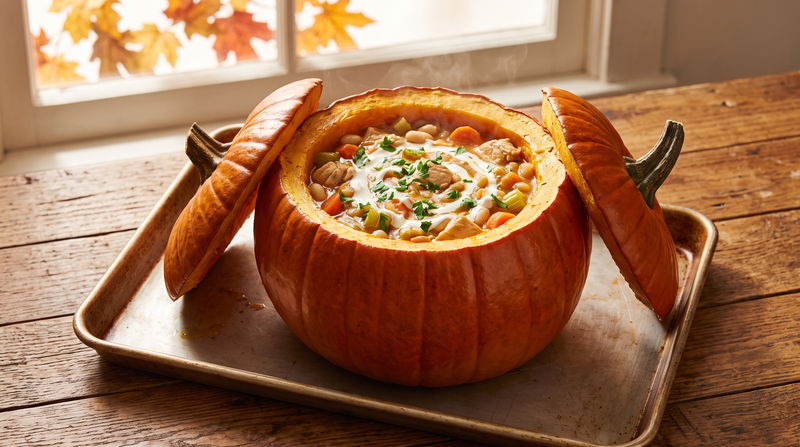
Recipe: Chicken and white bean stew baked in a pumpkin
Prep time: 30 minutes | Cook time: 1 hour 15 minutes to 1 hour 40 minutes | Serves: 4
Please note: This recipe is a starting point that I haven’t been able to test, and cooking times for pumpkins vary a lot with size and variety. Cook it once and adjust before you serve it to guests.
Ingredients
- 1 sugar pumpkin or similar edible pumpkin, about 4 pounds (1.8 kg), washed
- 1½ teaspoons fine salt, divided
- ½ teaspoon black pepper, divided
- 1 tablespoon olive oil
- 1 pound (450 g) boneless, skinless chicken thighs, cut into 1½-inch pieces
- 1 onion, diced
- 1 carrot, diced
- 3 cloves garlic, minced
- 1 teaspoon dried thyme
- 1 can (15 oz / 425 g) white beans, drained and rinsed
- ¾ cup (180 ml) low-sodium chicken broth
- ½ cup (120 ml) heavy cream or additional broth
- 1–2 teaspoons lemon juice or apple cider vinegar, to finish
- Chopped fresh parsley, to serve
Instructions
- Prepare the pumpkin. Heat the oven to 350°F (175°C). Cut a lid around the stem, tilted slightly so it doesn’t fall in, and scoop out the seeds and strings. Rub ½ teaspoon of the salt and ¼ teaspoon of the pepper inside the cavity. Set the pumpkin on a rimmed sheet pan lined with foil.
- Brown the chicken. Season the chicken with ½ teaspoon of the salt. Heat the oil in a large skillet over medium-high heat and brown the chicken for 3–4 minutes per side, working in batches if needed. It doesn’t need to be cooked through. Transfer it to a bowl.
- Build the filling. In the same skillet, cook the onion and carrot over medium heat for 5–6 minutes, until soft. Add the garlic and thyme and cook for 30 seconds. Pour in the broth and scrape up the browned bits from the bottom of the pan.
- Combine. Stir in the chicken, beans, cream, remaining ½ teaspoon salt, and remaining ¼ teaspoon pepper. Spoon the mixture into the pumpkin, leaving about 1½ inches of space at the top, since it will bubble. Put the lid on.
- Bake. Bake for 75 to 100 minutes, starting to check at about 60 minutes. The pumpkin is ready when a knife slides easily into the flesh, the filling is bubbling, and the chicken pieces reach 165°F (74°C) on an instant-read thermometer. If the pumpkin skin begins to sag or leak, stop and transfer the filling to a pot, as described below.
- Finish. Rest for 10 minutes. Stir in the lemon juice, then taste and add salt if needed. Scoop some of the soft pumpkin flesh into the stew as you serve, and top with parsley.
A lower-risk method
If you’re nervous about a collapsing pumpkin, cook the stew in a pot on the stove and use the pumpkin as a serving bowl. Roast the empty pumpkin, with the lid on, at 350°F (175°C) for about 30–40 minutes, until it’s just beginning to soften but still holds its shape. Fill it with the hot, finished stew and serve right away. You get the presentation with far less risk, and the stew’s flavor is easier to control. See our cooking habits guide for why browning and tasting at each stage matters.
How to get more flavor
The original poster in the discussion wanted to know how to avoid a bland result, which is the right question. Soup that tastes weak usually needs seasoning more than it needs more cooking.
| Problem | Fix |
|---|---|
| Tastes flat | Salt in stages, including the pumpkin cavity, then a squeeze of lemon or a splash of vinegar at the end. See flavor and color in cooking |
| No depth | Brown meat first, and cook onions, garlic, and tomato paste until they darken, since browning flavors don’t develop in a sealed pumpkin |
| Thin or watery broth | Use real stock instead of water. A homemade or good-quality stock adds body, and chilling it overnight can deepen the flavor |
| Dull spices | Toast or bloom them in oil first. See how to toast and bloom spices |
| Savory depth is missing | Add an umami ingredient, such as bouillon paste, soy sauce, miso, Parmesan, or mushrooms |
| Everything tastes the same | Finish with fresh herbs and freshly ground pepper, and add a little fat, such as olive oil or butter, to carry the flavors |
Food safety notes
- Cook meat to a safe temperature. Poultry should reach 165°F (74°C), ground meat 160°F (71°C), and beef, pork, or lamb pieces 145°F (63°C), measured in several places. A thick pumpkin can slow heating, so don’t rely on time alone.
- Don’t leave it out. Perishable food shouldn’t sit at room temperature for more than 2 hours, or 1 hour if it’s above 90°F (32°C).
- Store leftovers properly. Spoon leftovers out of the pumpkin into shallow containers, refrigerate within 2 hours, and use within 3–4 days. Reheat to 165°F (74°C). See our guide to storing food in the kitchen.
- Wash the outside. Scrub the pumpkin under running water before cutting it.
If you just want pumpkin soup
The easiest way to get a velvety soup is the one cooks have used for a long time: roast the pumpkin or squash until caramelized, scoop out the flesh, loosen it with stock, and blend. Roasting brings out sweetness that sealed steaming can’t, and it takes less cleanup. Our roasted butternut squash soup follows this method and works equally well with sugar pumpkin. For a vessel, you can roast a small pumpkin separately and serve the soup in it.
Troubleshooting
- The pumpkin collapsed: It was too large, too soft, or baked too long. Use a smaller pumpkin, check it early, and bake it on a rimmed pan or in a Dutch oven.
- The filling is dry: There wasn’t enough liquid. Add broth or cream, and don’t expect the pumpkin to supply it.
- It tastes bland: The filling wasn’t browned or seasoned enough. Salt the cavity, brown the meat and aromatics first, and finish with acid.
- The chicken is undercooked but the pumpkin is soft: Remove the filling to a pot, and finish cooking it on the stove until it reaches 165°F (74°C).
- The pumpkin is still hard: Bake longer, or use a smaller pumpkin. Dense varieties take more time.
FAQ
Is the “no-water soup in a pumpkin” trend real?
People do cook in pumpkins, and waterless soups are real. But the combination of a sealed pumpkin and no liquid doesn’t produce a pot of soup. Expect a moist, stewed filling at best.
Can I eat any kind of pumpkin?
Carving pumpkins are edible but watery and bland. Sugar or pie pumpkins and kabocha squash are better choices for cooking.
Is it worth cooking in a pumpkin at all?
It’s a fun presentation for a stew or casserole, especially at an autumn dinner. If your goal is the best-tasting soup, a regular pot is easier and more reliable.
What are some good fillings?
Thick stews with chicken or beef, rice dishes with dried fruit and nuts, or a baked mix of bread, cheese, and cream. Always include some liquid.
Conclusion
The “no-water soup in a pumpkin” trend makes for a good video, but the science doesn’t support it. Pumpkin doesn’t release enough liquid to make soup, and a softened pumpkin is a fragile pot. Cook in a pumpkin if you enjoy the ritual: add real liquid, choose an edible variety, bake it on a rimmed pan, and build flavor before it goes in. If you want the best bowl of pumpkin soup, roast the pumpkin, blend it, and serve it in the shell if you like.