By Harry Cruse | TasteSavory
Making granola at home seems like one of the simplest kitchen tasks, yet so many home cooks end up with disappointing results: dry, crumbly oats that look more like loose muesli than the crunchy, satisfying clusters you get from high-end bakeries. Getting those big, delicious slabs isn’t about luck—it comes down to understanding a few basic culinary mechanics regarding binders, liquid ratios, baking temperature, and pan handling.
By analyzing the most effective techniques shared by experienced home bakers and professional chefs, we’ve broken down the exact steps and secrets needed to produce crispy, perfectly clustered granola every single time.
The short answer
- Use a binder: Add a whisked, frothy egg white or a touch of fruit puree to bind dry ingredients together.
- Get the ratios right: Aim for approximately 1 cup of liquid (sweetener plus oil) for every 4 cups of dry ingredients.
- Press it flat: Pack the granola firmly into a single layer on a parchment-lined baking sheet before it goes into the oven.
- Bake low and slow: Keep oven temperatures between 225°F and 300°F so the sugars caramelize without burning.
- Do not stir while cooling: Let the granola cool completely on the pan before touching or breaking it into clusters.
1. Use the Right Liquid-to-Dry Ratio
The number one reason homemade granola stays loose and powdery is skimping on wet ingredients. For the oats, seeds, and nuts to stick together, they need enough liquid coat to form sticky bridges as the mixture heats up.
A reliable standard ratio is 1 cup of liquid sweetener and oil for every 4 cups of dry ingredients. If your mix includes a heavy concentration of small seeds like chia, flax, or sesame, you may even need to increase the wet mixture slightly to ensure those tiny particles are fully glued to larger oat flakes.
2. Choose Your Binders and Sweeteners
While honey and maple syrup add wonderful flavor, relying on syrup alone doesn’t always guarantee structural clusters once cooled. Incorporating a supplemental binder is the ultimate cheat code for large chunks:
- Foamy Egg White: Whisking an egg white until frothy and folding it into your coated mix acts as a neutral, protein-based glue that bakes into crispy, airy slabs.
- Applesauce or Banana: Substituting a portion of the fat with unsweetened applesauce or mashed ripe banana adds moisture and natural pectin, which helps create a chewy-crisp cluster.
- Tahini or Nut Butter: Mixing tahini or peanut butter into your warmed honey or syrup thins the fats while adding depth of flavor and extra binding power.
For more insights on how sweet and savory elements interact in baking, explore our guide on sweet and salty flavor combinations.
3. Pack the Tray and Limit Stirring
How you handle the tray before and during baking dictates the final texture of your granola:
- Line your pan: Always use parchment paper to prevent sticking and ensure even heat distribution.
- Press firmly: Once the granola is poured onto the sheet pan, use a spatula or the flat bottom of a measuring cup to compact it into a solid, uniform block.
- Minimize disturbance: Resist the urge to constantly toss or stir the granola in the oven. If your oven has hot spots, gently rotate the sheet pan halfway through or lightly nudge the outer edges inward without breaking the center sheet.
4. Low and Slow Bake Times
Granola contains sugars and delicate fats that burn quickly at high heat. Baking at lower temperatures—between 250°F and 300°F—allows moisture to evaporate gradually while allowing the sugars to gently caramelize across the whole batch.
For detailed advice on managing oven heat and baking fundamentals, check out our collection of 15 baking tips for beginners.
5. Add Fruits and Fine Add-ins Afterward
A frequent mistake is baking dried fruits alongside oats and nuts. Raisins, dried cranberries, and cherries dry out rapidly and turn into bitter, burnt bits when exposed to 45 minutes of oven heat. Always stir in dried fruit after the granola has been baked and removed from the oven.
Step-by-step master granola process
- Combine dry ingredients: Mix old-fashioned rolled oats, sliced almonds, pumpkin seeds, cinnamon, and a generous pinch of fine sea salt in a large bowl.
- Warm the wet mixture: Combine neutral oil or coconut oil with honey or maple syrup in a small pan over low heat until fluid and uniform.
- Coat thoroughly: Pour the warm liquid mixture over the dry oats and toss until every piece is coated.
- Fold in frothed egg white: Whisk 1 egg white in a small bowl until foamy, then fold it evenly through the wet oat mix.
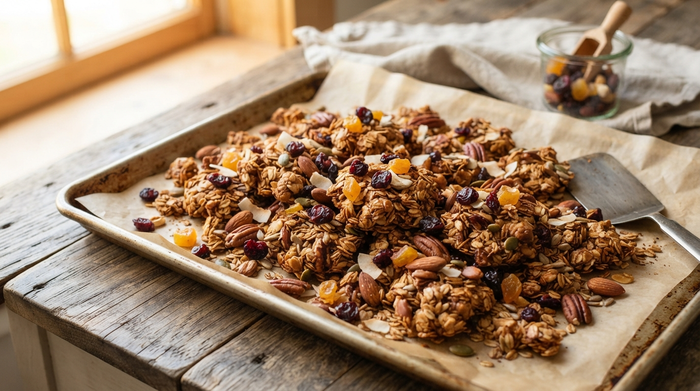
- Pack onto pan: Spread onto a parchment-lined sheet pan and press down firmly with a spatula into a flat, tight layer.
- Bake low: Bake at 275°F (135°C) for 40–50 minutes until golden brown, rotating the tray once halfway through.
- Cool untouched: Place the pan on a wire rack and allow it to cool completely for at least 45 minutes without stirring.
- Break into clusters: Break the cooled sheet into clusters and toss with dried fruit before storing.
Storage and keeping it crisp
Granola must be 100% cool before transfer to an airtight container. Trapping residual steam inside a jar will make the clusters soft and soggy. Stored in a cool, dry pantry, homemade granola stays fresh and crunchy for up to 4 weeks. For more tips on organizing your pantry and extending shelf life, read our kitchen food storage guide.
Troubleshooting common issues
| Problem | Likely Cause | Easy Solution |
|---|---|---|
| Granola is loose and powdery | Not enough liquid or sweetener; stirred too much while baking | Increase oil/syrup ratio or fold in a frothed egg white; press flat and don’t stir |
| Granola burnt on edges | Oven temperature too high; pan placed too close to heating element | Bake at 250°F–275°F on the center rack; gently push dark edges inward halfway through |
| Clusters are soft or chewy | Stored while still warm; insufficient baking time to evaporate moisture | Allow to cool completely on pan for 1 hour before sealing in glass jars |
FAQ
Can I make cluster granola without egg whites?
Yes. You can achieve clusters without egg white by using slightly more honey or maple syrup, mixing in a few tablespoons of applesauce or nut butter, pressing the mixture tightly onto the baking sheet, and letting it cool completely before touching it.
What type of oats work best for granola?
Old-fashioned rolled oats are ideal. Quick-cooking oats are cut too thin and absorb liquids differently, often turning powdery, while steel-cut oats remain too hard and dense when baked.
Why is my granola soggy after a few days?
This typically happens if the granola was packaged while still slightly warm or if stored in an unsealed container in a humid environment. Re-crisp it on a baking sheet at 250°F for 10 minutes, then let it cool thoroughly.
Conclusion
Making store-quality granola with big, crunchy clusters comes down to proper technique rather than complex recipes. By maintaining the right wet-to-dry ratio, utilizing a binder like frothed egg white, pressing the oats firmly onto your pan, and letting the batch cool undisturbed, you can make perfect homemade granola every time.