By Harry Cruse | TasteSavory
Good cooking starts before the stove. Food that’s stored well tastes better, lasts longer, and is safer to eat, while badly stored food wilts, dries out, or ends up in the trash. Most storage mistakes are simple ones: a full fridge door, meat on the wrong shelf, potatoes next to onions, a freezer bag with air still inside. This guide shows where each type of food belongs in the refrigerator, on the counter, in the pantry, and in the freezer, with practical time limits and fixes for common problems. The guidance follows USDA food-safety recommendations, which are intentionally cautious.
The short answer
- Keep the refrigerator at 40°F (4°C) or below and the freezer at 0°F (-18°C), and check both with an appliance thermometer.
- Put raw meat, poultry, and seafood on the lowest shelf, in sealed containers.
- Refrigerate perishable food within 2 hours of buying or cooking it, or within 1 hour if the air is above 90°F (32°C).
- Store produce according to type: some belongs on the counter, some in the fridge, and some should be kept apart.
- Wrap freezer food airtight, label it with the date, and thaw it in the refrigerator.
Set up the refrigerator by zone
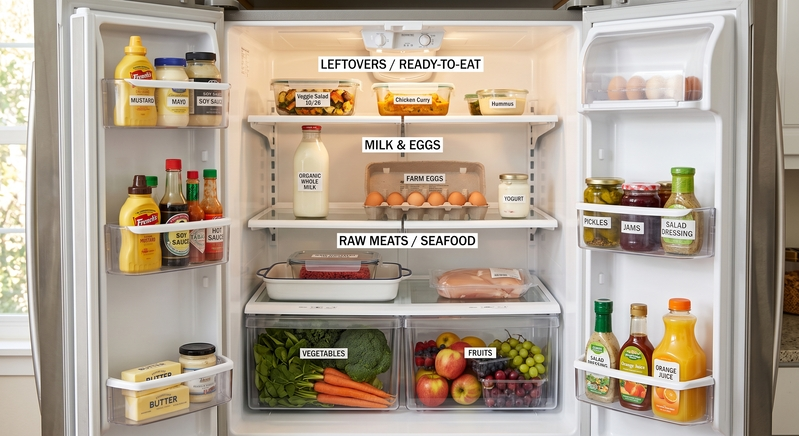
Refrigerators are not the same temperature everywhere. The door is the warmest part, and the back of the lower shelves is usually the coldest. Arranging food by zone keeps it colder where it matters and prevents raw juices from dripping onto food that won’t be cooked.
| Location | What to store | Why |
|---|---|---|
| Upper shelves | Leftovers, ready-to-eat foods, yogurt, deli items | Food you’ll eat without cooking stays above anything raw |
| Middle shelves | Milk, eggs in their carton, cheese, opened sauces | Steady temperature, away from the warm door |
| Lowest shelf | Raw meat, poultry, and seafood in sealed containers or on a rimmed tray | Any leaking juice can’t drip onto other food |
| Crisper drawers | Fruits and vegetables | Higher humidity slows wilting |
| Door | Condiments, jams, pickles, juice | These tolerate temperature swings; milk and eggs don’t |
Don’t pack the fridge so tightly that air can’t circulate, since cold air needs to move around food. Clean it regularly, and throw out spoiled food promptly so it doesn’t spread.
Storing raw meat, poultry, and fish
Raw poultry, ground meat, and fish are best used within 1–2 days of buying. Beef, pork, and lamb steaks, chops, and roasts keep 3–5 days. If you won’t cook them by then, freeze them right away, and don’t wait until the last day. Keep meat in its original packaging for a day or two, or wrap it loosely and place it in a container so the juices stay contained. Never wash raw meat or poultry, because the splashing can spread bacteria. Our guide to ways to cook meat explains how to match a cut to a cooking method once it’s ready to use.
Produce: what goes where
Fruit and vegetables don’t all want the same conditions, and storing them together can hurt both. Apples, bananas, avocados, and ripening tomatoes release ethylene gas, which speeds ripening of nearby produce. Keep them away from ethylene-sensitive items such as leafy greens, broccoli, and cucumbers.
| Store on the counter or in a cool, dark place | Store in the refrigerator |
|---|---|
| Potatoes, onions, garlic, winter squash (keep potatoes and onions apart) | Leafy greens, broccoli, carrots, cabbage, celery, cucumbers |
| Tomatoes (refrigeration can dull flavor and texture) | Berries, grapes, cut fruit |
| Bananas | Apples, for longer keeping |
| Unripe avocados, pears, and stone fruit, until ripe | Ripe avocados and pears, to slow further ripening |
| Citrus, for several days | Citrus, for longer storage |
| Basil, stems in a glass of water | Parsley, cilantro, and other soft herbs, stems in a jar of water, loosely covered |
Some habits help nearly everything. Don’t wash produce before storing it, because moisture speeds spoilage, and rinse it just before using. Store leafy greens wrapped in a paper towel inside a container, to absorb extra moisture. Keep mushrooms in a paper bag. Throw away potatoes that are soft, or that have large green areas or many sprouts. As a rough guide, carrots last 2–3 weeks in the refrigerator, cabbage 1–2 weeks, broccoli 3–5 days, cucumbers 4–6 days, and opened bagged greens about 2 days. Overripe bananas are ideal for our banana bread, or you can freeze them peeled.
Pantry and dry goods
The best pantry is cool, dry, and dark, away from the stove, dishwasher, and sunny windows, which all cause heat swings. Move opened packages into airtight containers, which keep out moisture, stale air, and pantry pests.
- Grains, pasta, and dried beans: Store in sealed containers. Dried beans and lentils keep for a year or two but cook unevenly when very old.
- Flour and baking supplies: Keep white flour airtight in a cool place. Whole-grain flours, nuts, and seeds contain oils that go rancid faster, so the refrigerator or freezer is a better home for them.
- Oils: Keep them tightly closed, away from heat and light.
- Spices: Store them away from the stove. Ground spices gradually lose flavor, so replace them about once a year.
- Canned goods: Discard cans that are bulging, leaking, or deeply dented. Once opened, move the contents to a covered container and refrigerate.
- Honey and sugar: Keep them at room temperature. Check the label on maple syrup, which is usually refrigerated after opening.
Freezer storage
Food held at a constant 0°F stays safe indefinitely, and the recommended times are about quality, meaning flavor and texture. Freezer burn, the dry, grayish patches on frozen food, is a quality problem rather than a safety one, and you can trim those spots away.
- Wrap airtight. Use freezer bags with as much air pressed out as possible, or well-sealed containers. Air is what causes freezer burn.
- Freeze flat. Flat bags freeze faster, stack neatly, and thaw more evenly.
- Label everything. Write the contents and date on the package.
- Portion first. Freeze in amounts you’ll actually use, so you don’t thaw more than you need.
- Thaw safely. Thaw in the refrigerator, in cold water, or in the microwave. Never thaw on the counter.
| Food | Approximate freezer quality |
|---|---|
| Ground meat | 3–4 months |
| Beef steaks and roasts | 6–12 months |
| Raw chicken pieces | About 9 months |
| Cooked soups, stews, and meat dishes | 2–3 months |
| Bread | About 3 months |
Cooked soups such as our easy beef chili freeze well in flat, labeled portions, and our tomato sauce does as well. Some foods don’t freeze well: cooked pasta in cream sauce, salads, raw eggs in the shell, and mayonnaise-based salads.
Storing leftovers
Refrigerate leftovers within 2 hours, in shallow containers so they chill quickly, and use them within 3–4 days. Reheat to 165°F (74°C), which an instant-read thermometer confirms. Cooked rice should go into the refrigerator promptly, because it can carry bacteria that survive cooking if it sits warm. Our meal prep guide covers batch cooking and portioning, and our holiday meal ideas include guidance for large meals with lots of leftovers.
A simple system for staying organized
- First in, first out. Put newer items behind older ones so the older food gets used first.
- Keep a “use first” spot. Give a fridge shelf or a basket to food that needs eating soon, such as cut fruit, leftovers, and open packages.
- Label leftovers and opened items. Masking tape and a marker are enough.
- Understand date labels. For most foods, “best by” and “use by” dates show peak quality rather than safety, with infant formula the exception. Storage time and temperature matter more. When in doubt, throw it out, because smell and appearance don’t reliably show whether food is safe.
Troubleshooting
- Produce spoils within a few days: It may be wet, stored near ethylene producers, or crammed into a drawer. Dry it, separate fruit from vegetables, and use a paper towel for greens.
- Freezer-burned food: Air reached the food. Wrap more tightly, squeeze air from bags, and trim affected areas before cooking.
- Bread goes stale quickly: The refrigerator dries it out faster. Keep bread at room temperature for a few days, and freeze slices for longer storage.
- Refrigerator smells: Find and remove the source, wipe shelves, and store strong-smelling foods in sealed containers.
- Pantry pests: Move grains and flour into airtight containers, and discard infested items.
- Food is cold at the door but warm elsewhere: The fridge may be overloaded. Check the temperature with a thermometer and leave room for air.
FAQ
Should eggs go in the refrigerator?
In the United States, yes. Commercially washed eggs are kept in the refrigerator, in their carton and not in the door, where they last about 3–5 weeks. Practices differ in other countries, so follow local guidance if you live elsewhere.
How long can food sit out?
No more than 2 hours, or 1 hour if it’s hotter than 90°F (32°C).
Can I refreeze thawed food?
Food thawed in the refrigerator can be refrozen safely, though quality may suffer. Food thawed in cold water or the microwave should be cooked before refreezing.
Is it better to store leftovers in glass or plastic?
Either works if it’s clean and has a tight lid. Glass is easy to reheat and doesn’t hold odors, while plastic is lighter.
Conclusion
Food storage is mostly habit. Keep your fridge and freezer at the right temperatures, put raw meat low and ready-to-eat food high, store produce according to its needs, and wrap what you freeze so it can’t dry out. Start by checking your refrigerator with a thermometer and reorganizing one shelf. A few small changes can cut waste and keep more of your groceries at their best.