By Harry Cruse | TasteSavory
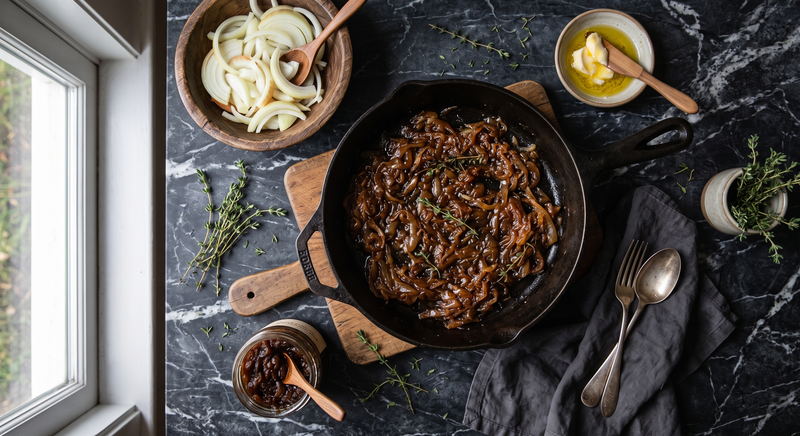
Slowly cooked until they’re deep brown, soft, and sweet, caramelized onions are one of the best flavor boosters in the kitchen. They take time, though, so once you’ve made a batch, it’s worth knowing how to use it. French onion soup is the classic, but it’s only the beginning. Caramelized onions improve burgers, grilled cheese, pasta, tarts, dips, mashed potatoes, and slow-cooked meats, and they’re the base of a whole family of dishes from the Middle East and South Asia. This guide explains how to caramelize onions properly (it takes 40 to 60 minutes, not 10), how to fix common problems, how to store and freeze them, and twenty ways to use them. It includes recipes for mujadara (lentils and rice with deeply browned onions) and a goat cheese and onion tart.
The short answer
- Slice yellow onions evenly, and cook them in a wide pan over medium to medium-low heat, with a little fat and salt.
- Expect 40 to 60 minutes, stirring now and then, until they turn a deep, even brown.
- Don’t rush with high heat, which burns the edges before the middles soften. Add a splash of water when the pan gets dry or sticky.
- Make a large batch, since onions shrink dramatically, and freeze extra portions.
- Use them anywhere you want a sweet, savory, deeply flavored layer.
What caramelizing really does
Onions contain natural sugars, and slow cooking drives off their water, softens them, and lets those sugars brown. The browning creates hundreds of new flavor compounds, which is why the result tastes sweet, savory, and slightly bitter-complex, not like raw or sautéed onion. This takes time because onions are mostly water, and the water has to cook away before browning can begin. Rushing the process on high heat only scorches the surface. The same principle of moisture, heat, and time drives most browning in the kitchen, as we describe in flavor and color in cooking.
How to caramelize onions
Prep time: 15 minutes | Cook time: 40–60 minutes | Makes: about 1½ cups
Ingredients
- 3 pounds (1.4 kg) yellow onions, about 4 large
- 2 tablespoons butter
- 1 tablespoon olive or neutral oil
- ½ teaspoon fine salt
- 2–3 tablespoons water, dry white wine, sherry, or balsamic vinegar, for deglazing
- Optional: a pinch of sugar, and ¼ teaspoon baking soda (see notes)
Instructions
- Slice evenly. Peel the onions, cut them in half from root to stem, and slice them about ¼ inch thick along the length. Even slices cook at the same rate.
- Start the pan. Melt the butter with the oil in a wide, heavy skillet or Dutch oven, about 12 inches, over medium heat. The onions will fill the pan at first, and a wide pan lets moisture evaporate.
- Add the onions and salt. Stir to coat. Cook for about 10 minutes, stirring occasionally, until the onions soften and release their liquid.
- Lower the heat and keep going. Reduce the heat to medium-low. Cook for another 25–40 minutes, stirring every few minutes and scraping the bottom, until the onions are a deep golden brown to mahogany and reduced to a jammy texture.
- Deglaze as needed. When browned bits stick to the pan, add a tablespoon of water, wine, or vinegar and scrape them up. Those bits carry flavor and color back into the onions.
- Finish. Taste, and add salt, pepper, or a splash of balsamic or sherry vinegar if they need brightness. Use them warm or let them cool.
Notes: Yellow onions give the best balance of sweetness and savory depth. Red onions are sweeter and a little more tangy, and sweet onions brown but taste milder. A tiny pinch of baking soda speeds browning by raising the pH, but use only about ¼ teaspoon for 2–3 pounds of onions, because more makes them mushy and gives them a soapy taste. Salt early to draw out moisture, and keep the heat at a level where the onions sizzle gently without scorching. Lower the heat if the bottom of the pan turns dark too soon.
Other ways to caramelize
- Slow cooker: Slice 3 pounds of onions into a slow cooker with 3 tablespoons of butter and a little salt. Cook on low, covered, for roughly 8–12 hours, until deep brown. Then uncover and cook on high or on the stovetop to evaporate any liquid. The result is softer and jammier, but takes much less attention.
- Oven: Spread sliced onions with fat in a covered Dutch oven at about 400°F (200°C), stirring every 20–30 minutes, for about an hour or more. It requires less stirring than a stovetop.
- Shortcuts: Some cooks soften sliced onions in the microwave for a few minutes first, or freeze and thaw them, which breaks down the cells so they release water sooner. These save some time, but results vary, and they aren’t a substitute for the long, slow browning.
Troubleshooting
- Burnt or bitter: The heat was too high. Lower it, add a splash of water, and stir more often. If the onions are black, start over.
- Pale and watery after 20 minutes: This is normal. Keep cooking, and don’t cover the pan. A crowded or small pan also slows evaporation.
- Not sweet enough: They need more time, or a little vinegar, sherry, or a pinch of sugar at the end.
- Too greasy: Use less fat next time, or blot them on paper towels.
- Uneven color: Slices were uneven, or the pan had hot spots. Stir more and slice consistently.
- Takes forever: It does take time. Make a double batch, and use the slow cooker if you can’t watch the pan.
Storing and freezing
Cool caramelized onions and refrigerate them in an airtight container within 2 hours. They keep for 3–4 days, and some cooks keep them longer under a thin layer of butter or oil, but the shorter time is safest. To freeze, portion them into ice cube trays, muffin cups, or flat bags, freeze until firm, and move them to a freezer bag. They keep for about 3 months, and you can break off exactly what you need. Reheat them gently in a pan, with a splash of water if they’ve dried out. See our guide to storing food in the kitchen for more, and our meal prep guide for batch-cooking ideas. If you’re thinking of making onion jam or chutney for long-term pantry storage, use a tested canning recipe from a reliable source, because home canning of low-acid foods needs specific acidity and processing times to be safe.
Recipe: Mujadara (lentils and rice with caramelized onions)
Mujadara is a classic Middle Eastern dish of lentils, rice, and deeply browned onions. It’s inexpensive, filling, and one of the best uses for a large batch of onions. This version is simple and meatless.
Prep time: 15 minutes | Cook time: 1 hour | Serves: 6
Ingredients
- ⅓ cup (80 ml) olive oil
- 3 large yellow onions (about 2 pounds / 900 g), thinly sliced
- 1 teaspoon fine salt, divided
- 1 cup (200 g) brown or green lentils, rinsed
- 4 cups (960 ml) water or low-sodium broth, plus a little more if needed
- 1 cup (185 g) long-grain rice, rinsed
- 1 teaspoon ground cumin
- ½ teaspoon ground coriander
- Pinch of ground cinnamon (optional)
- Black pepper, to taste
- Plain yogurt, chopped parsley, and lemon wedges, to serve
Instructions
- Cook the onions. Heat the oil in a large skillet over medium heat. Add the onions and ½ teaspoon of the salt, and cook for 35–45 minutes, stirring often and lowering the heat if needed, until deep brown and some are crisp at the edges. Set about a third aside for topping.
- Cook the lentils. Meanwhile, put the lentils and water in a large pot. Bring to a boil, then simmer for about 15 minutes, until partly tender.
- Add the rice. Stir in the rice, the remaining salt, cumin, coriander, cinnamon, and pepper, and the larger portion of the onions with their oil. Add a little more water if the pot looks dry.
- Simmer. Cover and cook over low heat for 15–20 minutes, until the rice is tender and the liquid is absorbed. Remove from the heat and rest, covered, for 10 minutes.
- Serve. Fluff with a fork, top with the reserved onions, and serve with yogurt, parsley, and lemon.
Notes: Lentil and rice brands differ in cooking time, so check the texture. It keeps for 3–4 days and reheats well with a splash of water.
Recipe: Caramelized onion and goat cheese tart
Prep time: 15 minutes (with prepared onions) | Cook time: 25–30 minutes | Serves: 6
Ingredients
- 1 sheet (about 9–10 ounces / 270 g) puff pastry, thawed according to the package
- 1½ cups caramelized onions, cooled
- 3 ounces (85 g) goat cheese
- ½ cup (50 g) shredded Gruyère or Swiss cheese
- 1 teaspoon fresh thyme leaves
- 1 egg beaten with 1 tablespoon water, for brushing
- Black pepper, and a drizzle of balsamic vinegar, to finish
Instructions
- Heat the oven to 400°F (200°C). Line a baking sheet with parchment.
- Unfold the puff pastry on the parchment. Score a ½-inch border around the edge with a knife, without cutting through, and prick the center with a fork.
- Sprinkle the Gruyère inside the border. Spread the onions over it, and crumble the goat cheese on top. Add the thyme and pepper.
- Brush the border with the egg wash.
- Bake for 25–30 minutes, until the pastry is puffed and deep golden. Drizzle with a little balsamic vinegar, cool for 5 minutes, and slice.
Notes: Add a layer of thin potato slices or roasted butternut squash, as in our roasted butternut squash soup flavors, for a heartier tart. Serve as an appetizer, as in our party appetizer guide, or with a salad for lunch.
Twenty ways to use caramelized onions
| Category | Ideas |
|---|---|
| Sandwiches and burgers | Patty melt, grilled cheese (with Gruyère or sharp cheddar), French dip, steak or roast beef sandwich, a topping for burgers, brats, and hot dogs |
| Pasta and grains | Creamy caramelized onion pasta, mujadara, rice pilaf, cheesy polenta or grits, mac and cheese (stirred into the sauce from our sauces guide) |
| Tarts, pizza, and eggs | Puff pastry tart, galette, quiche, flatbread or pizza with goat cheese or prosciutto, pissaladière, frittata, omelets |
| Dips and spreads | Caramelized onion dip (mix into sour cream and yogurt or cream cheese), hummus, onion and bacon jam, on a cheese board |
| Sides | Stirred into mashed potatoes, layered into potato gratin, tossed with green beans or bok choy, on baked potatoes |
| Main dishes | Smothered pork chops, braised chicken thighs, pot roast or brisket (see our meat guide), meatballs in onion gravy, sausage and mash with onion gravy |
| Beans and soups | White bean soup or stew with onions, chili (see our chili guide), onion-based curries and stews |
For a quick dip, mix 1 cup of chopped, cooled caramelized onions with 1 cup of sour cream, ½ cup of mayonnaise or Greek yogurt, a squeeze of lemon, and salt and pepper to taste, and chill for at least an hour. Our guide to fixing bland soup also suggests adding a spoonful of caramelized onions to soups that lack depth.
Flavor pairings
Caramelized onions are sweet and savory, so they pair well with salty, tangy, sharp, or rich ingredients: Gruyère, cheddar, goat cheese, blue cheese, bacon, mushrooms, balsamic vinegar, sherry, thyme, mustard, and beef. A splash of acid at the end balances the sweetness, as we explain in our guide to cooking habits.
FAQ
How long does it really take to caramelize onions?
At least 40 minutes, and often up to an hour, depending on the quantity and the heat. Recipes that say 10 minutes are describing sautéed onions.
Which onions are best?
Yellow onions are the standard. Red onions give a sweeter, tangier result, and shallots are delicate and quick.
Can I add sugar?
A pinch can help, but it isn’t necessary, because onions contain plenty of natural sugar.
Why are my onions bitter?
The heat was too high and the onions burned. Lower it, and add liquid when the pan gets dry.
How much will 3 pounds of onions make?
Roughly 1½ cups, because onions lose most of their volume as they cook.
Conclusion
Caramelized onions reward patience. Slice evenly, cook gently, stir now and then, and don’t rush. Make a big batch, freeze it in small portions, and you’ll have a ready-made source of sweet, savory depth for sandwiches, pasta, tarts, grains, and slow-cooked meals. Start with the mujadara or the tart, and then try the onions on your next burger or grilled cheese.