By Harry Cruse | TasteSavory
Plenty of home cooks make a perfectly good chili that still tastes like something is missing. The ingredient list looks right, the seasoning is right, and yet it doesn’t have the deep, layered flavor of the best bowls. The missing piece usually isn’t one secret ingredient. It’s a few techniques: using real dried chiles, browning properly, cooking the tomato paste and spices, adding savory and bitter notes like cocoa or dark beer, simmering long enough, and balancing the pot with acid at the end. This guide shows how to upgrade a basic chili, lists the add-ins worth trying and how much to use, and includes a fuller recipe that builds a dried-chile sauce. It also covers keeping the heat mild for children, thickening, storage, and troubleshooting. If you want the simple version first, start with our easy beef chili.
The short answer
- Replace some or all of the chili powder with a sauce made from dried chiles, such as ancho and guajillo, which are mild and flavorful.
- Use chuck roast, alone or with ground beef, for better texture and richer flavor.
- Brown the meat well, cook the onions until deeply golden, and cook the tomato paste and spices before adding liquid.
- Add one or two depth boosters, such as cocoa, dark beer, Worcestershire sauce, or chipotle in adobo sauce, not all of them.
- Simmer low and slow, and finish with acid and, if you like, a masa slurry.
Why chili can taste flat
A pot with beef, tomatoes, onion, peppers, beans, and chili powder is a good start, but it’s often missing a few things. Standard chili powder is a blend of spices, often including cumin, garlic, and oregano, so adding more of each on top can make the flavor muddy rather than deeper. A pot heavy on fresh vegetables, such as bell peppers, can taste vegetal rather than rich. Browning may be skimped, so the meat just turns gray and cooked. And a short simmer doesn’t give the flavors time to meld. Fixing any of these helps, and fixing several makes a big difference.
Step 1: Use real dried chiles
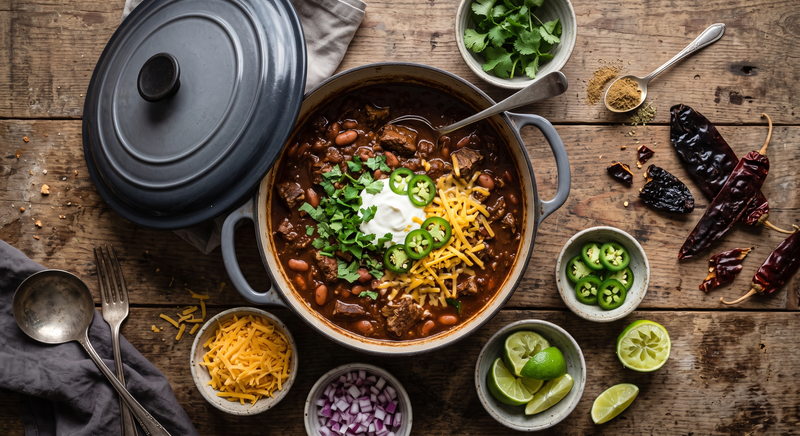
Dried chiles are what give a great chili its deep, fruity, slightly smoky flavor. They aren’t necessarily hot. Ancho (dried poblano) and guajillo are mild to medium, with raisin-like and berry-like notes, and New Mexico or California chiles are mild too. Chile de árbol adds heat if you want it. You can buy them in many supermarkets and Latin markets.
How to make a dried-chile paste
- Remove the stems and shake out the seeds from about 6 dried chiles, for example 4 ancho and 2 guajillo, about 2 ounces (55 g) in total. Tear them into flat pieces.
- Toast them in a dry skillet over medium heat for 20–40 seconds per side, pressing them flat, until fragrant and slightly softened. Don’t let them smoke or blacken, because burnt chiles taste bitter.
- Put them in a bowl, cover with 2 cups of boiling water, and soak for 20–30 minutes, until very soft.
- Blend the chiles with 1–1½ cups of the soaking liquid and 2 cloves of garlic until smooth. For a silkier texture, push the paste through a sieve.
This makes about 2 cups of paste. Stir it into the pot after the onions and tomato paste, in place of most of the chili powder. Wear gloves if you’re sensitive to chile oils, and be careful blending hot liquid, filling the blender no more than halfway and venting the lid.
Step 2: Pick better meat
Ground beef is convenient, but cubed chuck roast gives a more satisfying, meaty texture and a richer flavor, and it holds its shape through a long simmer. Many cooks use a mix of cubed chuck and ground beef, and some add short rib, sausage, chorizo, or a little lamb. Cut chuck into ½- to ¾-inch pieces, pat it dry, and brown it in batches so it sears instead of steams, as we explain in our guide to ways to cook meat. Ground beef at 80/20 has more flavor than leaner types. If you use chuck, plan on a longer simmer of about 2 to 2½ hours until it’s fork-tender.
Step 3: Build flavor in layers
- Brown the meat properly. Use a heavy pot over medium-high heat, and don’t crowd it. Deep brown crusts mean flavor.
- Cook the onions slowly. Take them to a deep golden brown over medium heat for 12–15 minutes.
- Cook the tomato paste. Stir 2–3 tablespoons in the pot for 1–2 minutes, until it turns a brick red and smells sweet.
- Bloom the spices. Add the ground cumin, oregano, and paprika to the hot fat for 15–30 seconds before adding liquid, as in our guide to toasting and blooming spices. If you use chili powder, bloom it the same way.
- Deglaze. Add beer, broth, or wine and scrape up the browned bits.
- Simmer low and slow. Keep it at a gentle bubble, partially covered, for at least 1½ hours, longer if you use chuck.
Secret ingredients worth trying
Choose two or three from this list, not all. The goal is depth that you can’t quite identify, not a dish that tastes like any one add-in.
| Ingredient | What it adds | Starting amount (6–8 servings) |
|---|---|---|
| Unsweetened cocoa powder | Richness and a slight bitterness, without tasting like chocolate | 1–2 teaspoons, up to 1 tablespoon |
| Dark beer or stout | Malty depth and a glossy sauce | 1 cup (240 ml), replacing some broth |
| Chipotle in adobo sauce | Smoky flavor and moderate heat | 1–2 teaspoons of the sauce, or 1 minced pepper for more heat |
| Worcestershire sauce | Savory, tangy umami | 1 tablespoon |
| Soy sauce or fish sauce | Deep savory flavor that doesn’t taste like itself | 1 teaspoon |
| MSG or beef bouillon paste | Beefiness and umami | A small pinch of MSG, or 1 teaspoon of paste. Reduce the salt |
| Brown sugar or molasses | Rounds out acidity and bitterness | 1–2 teaspoons |
| Coffee or espresso | Earthy, roasted notes | 1 tablespoon of instant espresso, or ½ cup brewed coffee in place of some broth |
| Cinnamon stick | Subtle warmth | 1 stick, removed before serving |
| Masa harina | Thickening and a toasty corn flavor | 2 tablespoons, mixed to a paste with cold water |
| Vinegar or lime juice | Brightness at the end | 1–2 teaspoons, to taste |
For more on how umami and acid balance a dish, see our guide to flavor and color in cooking, and for our approach to MSG, see our burger guide. Chili is forgiving, so add small amounts, taste, and adjust.
Recipe: Deeper beef chili with dried chiles
Prep time: 30 minutes | Cook time: 2½–3 hours | Serves: 8
Ingredients
- 1 batch dried-chile paste (about 2 cups), made as described above
- 2 pounds (900 g) boneless beef chuck, cut into ½-inch cubes
- 1 pound (450 g) ground beef, 80/20
- 2 tablespoons neutral oil, plus more as needed
- 2 large onions, finely diced
- 5 cloves garlic, minced
- 3 tablespoons tomato paste
- 1 tablespoon ground cumin
- 2 teaspoons dried Mexican oregano
- 1 teaspoon smoked paprika
- 1 tablespoon unsweetened cocoa powder
- 1 cup (240 ml) dark beer, or additional broth
- 2 cups (480 ml) beef broth
- 1 can (14.5 oz / 410 g) fire-roasted diced or crushed tomatoes
- 1 tablespoon Worcestershire sauce
- 2 teaspoons brown sugar
- 2 cans (15 oz / 425 g each) beans, such as pinto, kidney, or black, drained
- 2 tablespoons masa harina, mixed with ¼ cup cold water
- 2 teaspoons fine salt, plus more to taste
- 1–2 tablespoons apple cider vinegar or lime juice, to finish
- Toppings: sour cream, shredded cheddar, chopped onion, cilantro, lime wedges
Instructions
- Brown the beef. Pat the chuck dry and season with 1 teaspoon of the salt. Heat the oil in a large, heavy Dutch oven over medium-high heat. Brown the chuck in 3 batches, about 4–5 minutes per batch, without crowding, and transfer to a bowl. Brown the ground beef in the same pot for 6–8 minutes, breaking it up, and add it to the bowl. Pour off all but about 2 tablespoons of fat.
- Cook the onions. Add the onions to the pot with a pinch of salt, and cook over medium heat for 12–15 minutes, stirring, until deep golden brown.
- Build the base. Add the garlic and tomato paste, and cook for 1–2 minutes, until the paste darkens. Stir in the cumin, oregano, paprika, and cocoa for 15–30 seconds.
- Deglaze. Pour in the beer and scrape the bottom of the pot. Simmer for 2 minutes.
- Add the rest. Stir in the chile paste, broth, tomatoes, Worcestershire sauce, and brown sugar. Return the meat to the pot, with its juices.
- Simmer. Bring to a boil, then reduce the heat to low. Cover partly and simmer for 2 to 2½ hours, stirring occasionally, until the chuck is very tender. Add the beans for the last 30 minutes. Alternatively, cook it in a 325°F (165°C) oven, covered, for the same time.
- Thicken and finish. Stir in the masa mixture and simmer for 10 minutes, until thickened. Stir in the vinegar, a teaspoon at a time, then taste and add salt.
Notes: The chili tastes better after resting, so make it a day ahead if you can. If it’s too thick, add a splash of broth. If it’s too thin, simmer it uncovered for a while. The ground beef should reach 160°F (71°C), which an instant-read thermometer confirms, and a long simmer easily gets it there.
Keep it mild for kids
The flavor in this chili comes from the chiles’ depth, not from heat. Ancho and guajillo are mild, and removing the seeds and veins keeps them gentler. Use only a teaspoon or two of the chipotle adobo sauce, not the peppers themselves, and skip the chile de árbol and cayenne. Let adults add hot sauce, jalapeño, or chile flakes at the table. Some parents add diced butternut squash or sweet potato to the pot, which softens the flavor and adds sweetness. See our kids meals guide for more ideas on serving family meals that suit different tastes.
Thickening and texture
Chili should be thick but not pasty. Simmering uncovered reduces it, mashing some of the beans thickens it, and a small amount of masa harina (or crushed tortilla chips) adds body and a corn flavor like canned chili. A spoonful of refried beans, like the ones in our homemade refried beans, can also add creaminess. Our guide to thickening soup, stew, and chili covers each method in more detail.
Make ahead, store, and reheat
Chili usually tastes better the next day, after the flavors have had time to meld. Cool it quickly in shallow containers, refrigerate within 2 hours, and use it within 3–4 days. Freeze portions for up to about 3 months. Reheat until steaming hot, to 165°F (74°C), adding a splash of broth if it has thickened. See our guide to storing food in the kitchen for more.
Troubleshooting
- Still bland: Check that your spices are fresh, since old ones lose potency. Then add salt, a splash of acid, and an umami ingredient such as Worcestershire sauce or a pinch of MSG.
- Bitter: The chiles or spices burned. Toast chiles briefly, and bloom spices for only 15–30 seconds. A little brown sugar can soften bitterness.
- Too thin: Simmer uncovered, mash some beans, or add masa harina paste.
- Too thick: Stir in warm broth or water.
- Greasy: Skim the fat from the top, or chill the chili and lift off the solid fat.
- Too spicy: Add more beans or tomatoes, a little sugar, or serve with sour cream and cheese.
- Muddy flavor: You may have too many spices layered on top of chili powder. Use fewer, and let the chile paste lead.
- Chuck is tough: It needs more time. Keep simmering, and check every 20–30 minutes.
FAQ
What is the secret ingredient for great chili?
There isn’t just one, but dried chiles make the biggest difference. Cocoa, dark beer, Worcestershire sauce, and chipotle in adobo are the most popular boosters.
Does chili need beans?
That depends on the style. Traditional Texas-style chili has no beans, while many home recipes include them. Use what you like.
Can I use chili powder instead of dried chiles?
Yes, and a good-quality chili powder works fine. Dried chiles give more depth, and many cooks use both, with less chili powder.
Does the alcohol cook out of the beer?
Simmering reduces the alcohol significantly, but it doesn’t remove it entirely. Use broth instead if you avoid alcohol.
Can I make chili in a slow cooker?
Yes. Brown the meat and cook the onions, tomato paste, and spices on the stove first, then cook everything on low for 6–8 hours, until the meat is tender.
Conclusion
Great chili comes from layers: real dried chiles, good meat, deep browning, bloomed spices, a couple of savory boosters, a long simmer, and a bright finish. You don’t need every secret ingredient. Start with the dried-chile paste, add one or two items from the table, and cook it low and slow. Make it a day ahead, and you’ll get the kind of rich, rounded flavor that tastes much more than the sum of its parts.