By Harry Cruse | TasteSavory
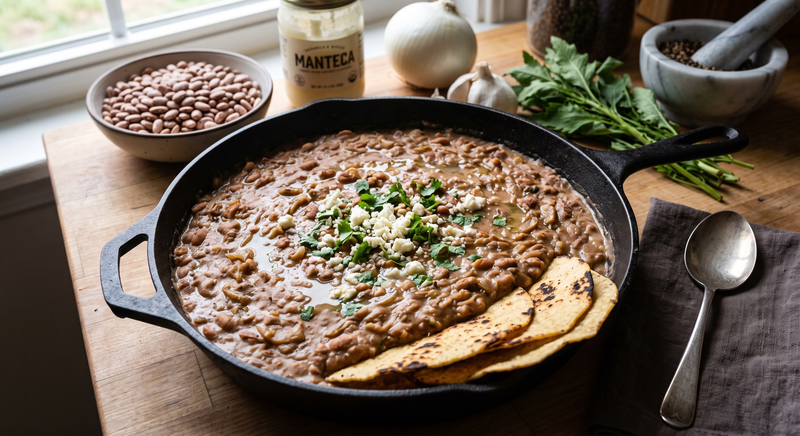
Good refried beans are creamy, savory, and deeply flavored, with a rich taste that’s hard to find in a can. Most home cooks start with the same basics (pinto beans, fat, onion, garlic, and salt) and still wonder why theirs don’t taste like the restaurant’s. The difference usually isn’t a secret ingredient. It’s a handful of choices: the kind of fat, how long the onions cook, how fresh the beans are, how much of the cooking liquid you add back, and a few finishing touches. This guide explains those choices, gives a full recipe from dried beans and a faster one from canned, and covers variations, vegetarian options, storage, and troubleshooting.
The short answer
- Fat is the biggest flavor factor. Fresh lard or bacon fat gives the richest result, and oil or butter works for other diets.
- Cook the onions slowly until deeply golden, and add the garlic late so it doesn’t turn bitter.
- Start with good, relatively fresh dried beans, and cook them until completely tender.
- Save the cooking liquid, and add it back gradually while mashing.
- Finish with salt and a little acid, such as lime juice or vinegar, and consider optional boosters like Mexican oregano, epazote, or a pinch of bouillon.
Start with the beans
Pinto beans are the standard, and they mash into a creamy, earthy base. Some cooks prefer mayocoba beans, also sold as canary, Peruvian, or Mexican yellow beans, which are especially smooth when blended. Black beans make a different, slightly sweeter version. Whatever you choose, freshness matters. Dried beans that have sat on a shelf for years can stay stubbornly firm, no matter how long they cook, and they never turn creamy. Buy beans from a store with high turnover, and use them within about a year. Sort them for stones, rinse them, and soak them if you like. Soaking shortens the cooking time but isn’t required, and adding salt to the pot doesn’t make beans tough, despite the old myth.
Cook dried beans safely
Raw dried beans contain natural compounds that can cause stomach upset if the beans are undercooked. Bring them to a vigorous boil for at least 10 minutes, then simmer them until fully soft. This matters especially if you use a slow cooker, where low heat may not get raw beans hot enough, so boil first, or use the high setting. Beans should be completely tender, with no chalky center.
Choose your fat
| Fat | Flavor | Notes |
|---|---|---|
| Fresh rendered lard (manteca) | Rich and savory, with a classic flavor | Best from a butcher or Mexican market. Many cooks find shelf-stable block lard milder |
| Bacon fat | Smoky and salty | Easy to find, and good with a little cumin. Use less salt |
| Chorizo fat | Spiced and bold | Cook the chorizo first and use the fat |
| Duck fat | Rich, without pork | A good alternative for people who avoid pork |
| Butter | Creamy and mild | Browns quickly, so use medium-low heat |
| Neutral oil, such as avocado or vegetable oil | Clean | The vegetarian option, which needs more seasoning |
You need enough fat for the onions and beans to cook in a generous layer, since fat carries flavor and gives the beans their silky texture. Use at least 3 tablespoons for a pound of dried beans, and more if you like.
Cook the onions slowly
The onions are the backbone of the flavor. Cook them in the fat over medium-low heat for 12–15 minutes, stirring now and then, until they’re soft and a deep golden brown, which brings out their sweetness and savory notes. Rushing them on high heat gives sharp, raw, or burnt flavors. Add the garlic only in the last minute, because it burns quickly and turns bitter. If you want chile flavor, stir in ground chile, such as ancho, or a minced jalapeño or serrano, with the garlic and let it cook briefly in the fat, a technique we describe in our guide to toasting and blooming spices.
Recipe 1: Refried beans from dried pinto beans
Prep time: 15 minutes, plus optional soaking | Cook time: 2½–3 hours | Makes: about 6 cups, serving 8
For the beans
- 1 pound (450 g) dried pinto beans, sorted and rinsed
- ½ white onion, in one piece
- 3 cloves garlic, peeled
- 1 bay leaf
- 1–2 sprigs fresh epazote, or 1 teaspoon dried (optional)
- 2 teaspoons fine salt
- About 8 cups (2 liters) water
To refry
- ¼ cup (60 ml) fresh lard, bacon fat, or oil
- 1 large white onion, finely diced
- 3 cloves garlic, minced
- 1 tablespoon ancho chile powder, or 1 minced jalapeño or serrano (optional)
- ½ teaspoon ground cumin (optional, and use a light hand)
- ½ teaspoon dried Mexican oregano
- 1–1½ teaspoons fine salt, to taste
- 1–2 tablespoons lime juice or white vinegar
Instructions
- Cook the beans. Put the beans, the onion half, garlic, bay leaf, epazote, and water in a large pot. Bring to a vigorous boil for 10 minutes, then reduce the heat to a gentle simmer, partly covered. Cook for about 1½–2½ hours (less if soaked), adding the 2 teaspoons of salt after the first hour and topping up with hot water so the beans stay covered, until completely creamy-tender.
- Drain and save. Drain the beans, reserving at least 2 cups of the cooking liquid. Discard the onion half, garlic, bay leaf, and epazote.
- Brown the onions. Heat the fat in a large, heavy skillet or Dutch oven over medium-low heat. Add the diced onion and cook, stirring, for 12–15 minutes, until deep golden brown.
- Add the aromatics. Stir in the garlic, chile, cumin, and oregano, and cook for 30–60 seconds, until fragrant.
- Add the beans. Add the drained beans and about ½ cup of the reserved liquid. Mash with a potato masher, or blend with an immersion blender, until as smooth or chunky as you like.
- Simmer. Cook over medium-low heat for 10–15 minutes, stirring often, adding more liquid a little at a time, until creamy. They’ll continue to thicken as they cool, so leave them a little looser than you want.
- Season. Add the salt and lime juice. Taste and adjust.
Notes: Add the liquid gradually, because it’s easier to thin beans than to thicken them. For a deeper flavor, some cooks fry the drained whole beans in hot fat for several minutes before mashing, letting the skins brown and break down. Be careful, because beans in hot fat can spatter and burn quickly.
Recipe 2: Quick refried beans from canned beans
Prep time: 10 minutes | Cook time: 20 minutes | Makes: about 3 cups, serving 4
Ingredients
- 3 tablespoons lard, bacon fat, or oil
- ½ medium white onion, finely diced
- 2 cloves garlic, minced
- ½ teaspoon ground cumin and ½ teaspoon dried Mexican oregano (optional)
- 2 cans (15 oz / 425 g each) pinto beans, drained, with the liquid reserved
- ½–1 cup reserved bean liquid or broth
- Salt, to taste, and a squeeze of lime
Instructions
- Heat the fat over medium-low heat. Cook the onion for 8–10 minutes, until golden.
- Add the garlic and spices, and cook for 30 seconds.
- Add the beans and ½ cup of liquid. Mash well.
- Simmer for 8–10 minutes, adding liquid as needed, until creamy.
- Taste, then season with salt and lime. Canned beans are already salted, so add salt gradually.
Flavor boosters, explained
- Mexican oregano and epazote: Mexican oregano is earthy and citrusy, and it’s a different plant from Mediterranean oregano. Epazote is a pungent herb that’s traditional with beans, and some cooks say it also makes them easier to digest. Both are available at Latin markets, and dried versions work.
- Savory boosters: A small pinch of chicken bouillon or MSG adds depth, since both are rich in glutamates that boost savory flavor, as we explain in our guide to flavor and color in cooking. Bouillon is salty, so reduce the salt and taste as you go. Vegetarians can use mushroom powder or a vegetable bouillon.
- Acid: Lime juice, white vinegar, or a splash of pickled jalapeño brine brightens the richness.
- Heat and smoke: A chipotle in adobo, a dried chile, or smoked paprika adds smokiness. Add it in small amounts.
- Creamy finishes: A spoonful of sour cream, cream, or cheese stirred in at the end makes the beans richer, though it’s not traditional in every style.
- Fresh finish: Chopped cilantro, scallions, or crumbled queso fresco on top.
Variations
- Chorizo refried beans: Cook 4–6 ounces of fresh chorizo until fully done, to 160°F (71°C), then use its fat for the onions and stir the crumbled meat into the beans.
- Black refried beans: Use the same method with black beans, and add a little extra lime.
- Cheesy: Stir in queso fresco, Oaxaca, or shredded cheddar at the end, and let it melt.
- Vegetarian or vegan: Use oil, plus smoked paprika or chipotle for smokiness and mushroom powder for depth. Check that any bouillon is vegetarian.
- Smoky: Cook the beans with a smoked ham hock, remove the bone, and shred the meat into the beans. This adds a deep, savory flavor.
How to serve them
Serve refried beans in burritos, tacos, tostadas, nachos, and quesadillas, as a side with rice, or with eggs for breakfast. They make a good base for layered dips, as in our party appetizer guide. Top with cheese, cilantro, salsa, or sour cream. A spoonful stirred into chili can also add body, as we note in our guide to thickening soups and stews.
Storage, freezing, and reheating
Cool the beans and refrigerate them within 2 hours, in a shallow container. They keep for 3–4 days. To freeze, portion them into flat bags or small containers and freeze for up to about 3 months. Beans thicken a lot as they sit, so reheat them in a pan with a splash of water or broth, stirring, until they’re steaming hot, to 165°F (74°C). See our guides to storing food and meal prep for more.
Troubleshooting
- Beans stay hard or gritty: They may be old, or they weren’t cooked long enough. Keep simmering, and use fresher beans next time.
- Too thick: Stir in warm bean liquid, broth, or water, a few tablespoons at a time.
- Too thin: Simmer uncovered, stirring, until it reduces, or mash in a few more beans.
- Bland: It needs more salt, fat, or acid. Add a little at a time, and taste.
- Bitter: The garlic or onions burned. Cook them over lower heat, and add the garlic last.
- Greasy: Too much fat for the amount of beans, or it didn’t blend in. Stir in a little hot liquid.
- Pale or gray color: A little ground ancho chile or paprika adds a warm color.
- Stuck to the pan: Stir more often, lower the heat, and add liquid.
FAQ
Do refried beans have to be fried?
The name comes from the Spanish frijoles refritos, which means well-fried beans, rather than beans fried twice. They’re cooked and mashed in hot fat, and the frying adds flavor.
Is lard necessary?
No, but it gives the classic flavor. Bacon fat, duck fat, butter, or oil all work, and the other flavors do most of the work in a vegetarian version.
Can I make refried beans in a slow cooker?
Yes, for cooking the dried beans. Boil them for 10 minutes first, then cook them in the slow cooker until fully tender, and finish them in a skillet.
Should I soak the beans?
It’s optional. Soaking shortens the cooking time, but unsoaked beans still turn out fine with a longer simmer.
Why do my canned beans taste better after I fry them?
Cooking the onions and beans in fat adds flavor and a creamy texture that canned beans lack.
Conclusion
The “secret” to amazing refried beans is mostly technique: good fat, slowly browned onions, fully tender beans, and just enough cooking liquid for the right texture. Season with salt and a little acid, and add one or two boosters if you like. Start with the dried bean recipe once, so you know the baseline, then use the canned version for weeknights and adjust the fat, chile, and finishing touches to your own taste.