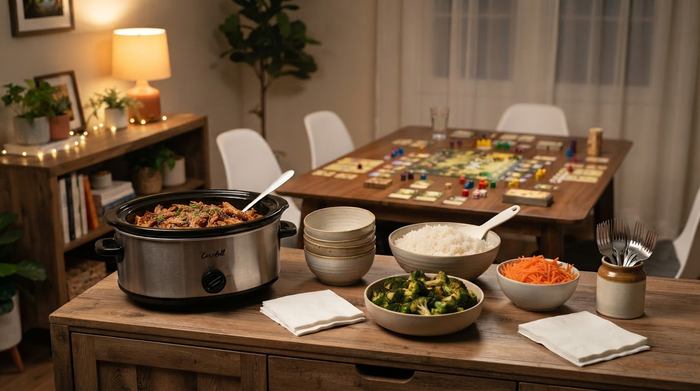
By Harry Cruse | TasteSavory
A good game night can run five or six hours, and the food has to survive all of it. It should be easy to eat without a knife, kind to cards and game pieces, and still safe and appealing hours after it came out of the kitchen. That rules out a lot of dinners, but it leaves plenty of good ones. This guide covers five rules for game-night food, twenty ideas that follow them, a food-safety plan for long events, and an original slow-cooker chicken bowl recipe that feeds a crowd.
The short answer
- Serve food in a bowl or cup, eaten with a spoon or fork, so no one has greasy fingers on the game.
- Choose dishes that hold up for hours: slow-cooker meals, bowl bars, and thick stews work best.
- Keep hot food at 140°F (60°C) or above and cold food at 40°F (4°C) or below. Don’t leave perishable food out for more than 2 hours.
- Set up a self-serve station away from the game table, with napkins and plenty of small bowls.
Five rules for game-night food
| Rule | Why it matters | Example |
|---|---|---|
| Keep hands clean | Grease and sauce transfer to cards, boards, and pieces | Food on skewers or eaten with a fork |
| One utensil, no cutting | A knife and fork take up space and attention | Bite-sized pieces in a bowl |
| Contained | Spills happen, and thick food spreads less than thin food | Chili or stew in a mug or bowl, not a plate |
| Holds for hours | People eat at different times during a long game | Slow-cooker dishes kept warm |
| Self-serve | Guests can eat during their own turn without stopping the game | A station with toppings and extra bowls |
Twenty ideas that follow the rules
Bowls and bars
- Rice bowls: Teriyaki chicken or beef with rice and roasted vegetables. A recipe follows below.
- Taco or burrito bowls: Seasoned meat or beans, rice, cheese, and toppings, with chips for scooping.
- Baked potato or mashed potato bar: A base and toppings such as cheese, chili, sour cream, and scallions.
- Mac and cheese bar: A pot of mac and cheese with add-ins like bacon, peppers, or breadcrumbs.
- Korean-style beef bowls or bibimbap: Keep the sauce on the side so the rice doesn’t get soggy.
Slow-cooker and spoon foods
- Chili: Thick, filling, and easy to customize. See our easy beef chili for a simple version.
- Japanese-style curry with rice: A big pot of beef or chicken, potatoes, and carrots in a thick sauce.
- Stew or chowder: Thick enough to stay in the bowl. Serve in mugs if you want even less spillage.
- Pulled chicken or pork: Cooked in the slow cooker, served over rice or potatoes.
- Meatballs in sauce: Kept warm in a slow cooker, with toothpicks or forks.
Handheld, but contained
- Hand pies, pasties, or empanadas: The crust keeps hands clean and the filling inside.
- Steamed buns: No knife needed, and you can offer a few fillings.
- Dumplings or potstickers: Easy to pick up with chopsticks or a fork; see our wonton wrapper ideas.
- Foil-wrapped burritos: The wrapper keeps fillings in and hands clean.
- Mini calzones or stromboli slices: Cut into small pieces and served with napkins.
On a stick or toothpick
- Skewers: Chicken, beef, or vegetable kabobs, grilled or broiled.
- Caprese picks: Cherry tomatoes, mozzarella pearls, and basil on toothpicks.
- Pinwheels: Tortillas rolled with meat and cheese, sliced, and pinned with a toothpick.
Cold, no-hands options
- Charcuterie with picks: Cheese cubes, cured meats, olives, and fruit.
- Sushi or rice rolls: Bite-sized, with chopsticks or fingers if needed. Keep raw fish cold and serve in small batches.
For more crowd-friendly snacks and how to plan quantities, see our guide to party appetizers that disappear first.
Foods to skip
- Powdery or greasy snacks, such as dusty cheese puffs, which leave residue on cards and pieces.
- Sticky or sauce-heavy finger foods, like saucy wings or anything glazed.
- Soups that are thin or served in open bowls, because liquid spills spread.
- Anything that needs a knife.
Food safety for a 5 to 6 hour game
A long event is where food safety can slip, because food sits out for hours.
- Keep hot food hot. Hold it at 140°F (60°C) or above in a slow cooker, chafing dish, or warming tray. Check with an instant-read thermometer.
- Use the warm setting only for holding. A slow cooker’s warm setting is meant to keep cooked food hot, not to cook or reheat it. Bring food to steaming (165°F/74°C) on the stove or in the microwave before moving it to a preheated cooker.
- Keep cold food cold. Hold it at 40°F (4°C) or below by nesting bowls in ice, or serve small trays and replace them with fresh ones from the refrigerator.
- Watch the clock. Perishable food shouldn’t be left out at room temperature for more than 2 hours, or 1 hour if it’s hotter than 90°F.
- Serve in rounds. For a long game, put out half the food at the start and keep the rest hot or cold until you refill.
- Refrigerate leftovers promptly, within 2 hours, in shallow containers. See our kitchen storage guide.
- Label ingredients. Guests may have allergies or dietary needs. A bowl bar helps, since everyone can build their own, but label toppings and keep serving spoons separate.
Set up the table
- Put the food on a separate table or counter, away from the game.
- Offer small bowls, forks, and napkins, and expect people to take a new bowl for each course.
- Provide damp towels or wipes, so guests can clean their hands before their turn.
- Use drinks with lids or in sturdy cups, and keep them on side tables when possible.
- Ask guests to bring something specific, like fruit or a salty snack, and add it to the self-serve table.
Recipe: Slow-cooker teriyaki-style chicken bowls
Prep time: 15 minutes | Cook time: 4 to 6 hours on low | Serves: 8
Ingredients
- 3 pounds (1.4 kg) boneless, skinless chicken thighs, thawed
- ½ cup soy sauce
- ¼ cup honey
- 2 tablespoons rice vinegar
- 1 tablespoon grated fresh ginger
- 4 cloves garlic, minced
- 1 tablespoon sesame oil
- ¼ cup water
- 1 tablespoon cornstarch mixed with 2 tablespoons cold water
- To serve: about 3 cups uncooked rice, cooked; roasted broccoli, sliced cucumbers, shredded carrots, scallions, and sesame seeds
Instructions
- Mix the sauce. Stir the soy sauce, honey, vinegar, ginger, garlic, sesame oil, and water together in the slow cooker.
- Add the chicken. Nestle the thighs into the sauce and turn to coat.
- Cook. Cover and cook on low for 4 to 6 hours, or on high for 2½ to 3½ hours, until the chicken is very tender and at least 165°F (74°C). Times vary by appliance.
- Shred. Remove the chicken, shred it with two forks, and return it to the pot.
- Thicken. Stir in the cornstarch mixture, set to high, and cook uncovered for about 10 minutes until the sauce thickens enough to cling to the meat.
- Keep warm. Switch to the warm setting, and check with a thermometer that it stays at or above 140°F (60°C).
- Serve. Set out the rice in a warm container and the toppings in small bowls.
Notes
- Soy sauce brands vary in saltiness, so taste before adding more.
- Keep the rice hot until serving, and refrigerate leftovers within 2 hours.
- For a vegetarian version, use chickpeas or extra-firm tofu and shorten the cooking time.
Make-ahead plan
| When | What to do |
|---|---|
| Day before | Chop toppings, make sauces, and cook chili or curry if using; our meal prep guide has tips for batching |
| Morning | Start the slow cooker, and prepare cold dishes and skewers |
| One hour before | Cook rice, set up the serving table, and put out bowls and napkins |
| During the game | Refill in small batches, and check temperatures |
Troubleshooting
- The food is cold by hour three: Use the warm setting for holding, and keep the lid closed. Serve in two rounds.
- The chicken is dry: It cooked too long. Use thighs instead of breasts, and stop at tender.
- The toppings are soggy: Keep sauces on the side and add toppings to the bowl just before eating.
- The sauce is too thin: Cook it uncovered on high, or add another small cornstarch slurry.
- Spills keep happening: Switch to thicker foods and smaller bowls, and put drinks on side tables.
FAQ
What’s the least messy food for game night?
Thick dishes in a bowl eaten with a spoon or fork, such as chili, curry, and rice bowls, or foods on skewers.
Is pizza okay?
Yes, if guests use napkins and wipe their hands before touching the game. Cutting it into small squares helps.
How much should I make?
Plan roughly a cup or more of the main dish per person, plus the base, and add extra for a long game. Leftovers freeze well.
How long can food sit out?
Perishable food shouldn’t be at room temperature for more than 2 hours. Keep hot food above 140°F and cold food below 40°F.
Conclusion
The best game-night meal is one that people can eat with a single utensil, that stays hot for hours, and that doesn’t put grease on the cards. Choose a bowl, a stew, or a skewer; keep the food at safe temperatures; and set up a self-serve table away from the game. Then everyone can eat when it suits them and stay focused on the game.