By Harry Cruse | TasteSavory
“What’s for dinner?” is one of the most tiring questions in any household, because it comes back every single day. Some people plan a full week on Sunday, others decide each evening based on what’s in the fridge, and plenty land somewhere in between. There’s no single right system. The best one is the one you’ll actually follow, and that depends on your schedule, your budget, your household, and how much you enjoy cooking. This guide describes seven approaches home cooks use, shows how to choose among them, and walks through a simple weekly routine, a sample week, a pantry staples list, and the food-safety habits that make planning work.
The short answer
- Start by looking at what you already have, what’s on sale, and what your week looks like.
- A planning pattern, such as a fixed mix of chicken, fish, vegetarian, and leftover nights, takes much of the effort out of deciding.
- Plan fewer meals than there are days. Leave room for leftovers, a quick meal, and a takeout night.
- Thaw meat in the refrigerator, and use delicate fish and produce early in the week.
- Keep a stocked pantry, so a plan can change without a trip to the store.
Why planning helps
Planning meals ahead reduces the daily decision, makes shopping faster, and helps you use what you buy before it spoils. It also makes it easier to eat the way you intend to, since most of us order takeout when we’re tired and have no plan. But planning has costs too. A plan that’s too rigid breaks the first time you’re busy, tired, or just not in the mood for what’s on the list. The goal is a plan flexible enough to survive a real week.
Seven ways to plan
1. Plan around what’s on sale and what you already have
Many cooks start with the store flyer, the freezer, and the fridge. Check what needs to be used up, scan the week’s sales for meat and produce, and build meals around those items. This approach saves money and reduces waste, because it uses what’s cheap and what’s about to spoil. Buying proteins on sale and freezing them in meal-sized portions makes it easy to repeat. The weakness is that it needs a little creativity, and it works best for people comfortable improvising.
2. Plan the protein, and keep the sides flexible
Choose the main protein for each night, and let the starch and vegetable follow from what’s in the house. For example, plan chicken on Monday and fish on Wednesday, then pair them with rice, potatoes, or roasted vegetables as you like. It’s simple, since the protein is usually the most expensive and least flexible part of a meal, and it works well with a freezer stocked with portioned meat.
3. Use a weekly pattern
A pattern is a template that decides the category of each dinner without choosing the recipe. One household might do two chicken dinners, one seafood, three vegetarian, and one clean-out-the-fridge night each week. Another might have a fixed pizza night on Friday and a soup night on Sunday. Because the pattern is fixed, you only have to pick a recipe for each category. It’s a good fit for people who find open-ended choices tiring.
4. Keep a master list or a rotation
Write down 15 to 50 dinners your household reliably enjoys, sorted into groups, and pick from the list each week. Some families go further and set up a rotation, such as three weeks of five dinners each, so the planning is done once and repeated. A good list also helps households with picky eaters, because every item has already been vetted. It takes an hour or so to build, and it saves far more time later. Our kids meals guide has ideas for building meals that suit mixed tastes.
5. Cook in bulk once or twice a week
Instead of planning daily dinners, some cooks make a few large dishes on a weekend and eat from them for several days. A pot of chili, a tray of roasted vegetables, and a batch of rice can turn into different meals over a few days. A midweek cooking session of 30–45 minutes refreshes the supply. This approach suits people who like to cook in a single burst and eat without thinking the rest of the week. Our meal prep guide explains how to cook and store components safely.
6. Keep a stocked kitchen and decide daily
Some people don’t write a plan at all. They keep a well-stocked pantry, freezer, and fridge, and decide each evening based on mood and ingredients. It works well if you have a reliable repertoire of go-to meals and shop often, and it fails if the stock runs low or you’re tired and uninspired. If you prefer this style, keep a short list of five or six dishes you can make from staples in 30 minutes.
7. Build a rolling shopping list
Rather than starting from scratch each week, keep a running list or online cart where you add items as they run low or as you see recipes you want to try, and prune it before you order. It’s particularly helpful for grocery delivery, and it ensures you never forget the basics.
Which method should you choose?
| If you… | Try |
|---|---|
| Want to save money and avoid waste | Plan around sales and what you have, with a freezer of portioned proteins |
| Are tired of making decisions | A weekly pattern or a rotation |
| Feed picky eaters or a mixed household | A master list of tested dinners |
| Don’t want to cook every night | Bulk cooking once or twice a week |
| Hate rigid plans | A stocked kitchen, plus two or three planned meals |
| Shop by delivery or pickup | A rolling cart or list |
Most people end up combining two or three of these. A common mix is a pattern for the week, a freezer of proteins bought on sale, and a few bulk-cooked components.
A 20-minute weekly routine
- Check the calendar. Note busy nights, late meetings, and evenings you’ll eat out. Plan quick meals for the busiest days and more involved cooking for the weekend.
- Check what you have. Look in the fridge, freezer, and pantry. List anything that needs to be used soon.
- Scan the sales. Look at the store flyer or app for meat, fish, and produce.
- Choose dinners. Plan 4–5 cooked dinners, not seven. Use your pattern, rotation, or master list. Include one use-it-up meal, one leftover night, and room for takeout.
- Match shared ingredients. If two meals use the same herb, vegetable, or sauce, you buy less and waste less.
- Write the shopping list. Organize it by store section so shopping is faster.
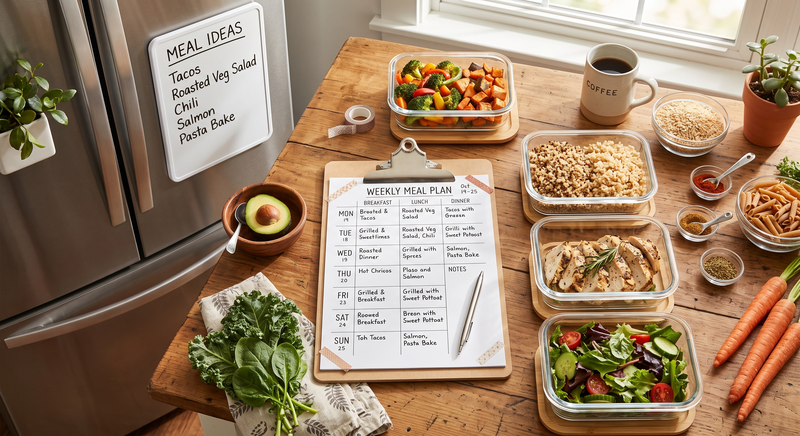
- Post the plan. Put it on the fridge, a whiteboard, or a shared calendar so everyone knows what’s coming and can help. Cross meals off as you cook them, and move any unmade meals to next week.
A sample week
This sample uses recipes from TasteSavory. Swap in your own favorites.
| Day | Dinner | Notes |
|---|---|---|
| Sunday | Pot roast | A longer cook, with leftovers for the week |
| Monday | Leftover pot roast sandwiches or a rice bowl with vegetables | No new cooking |
| Tuesday | Pan-seared chicken with rice and a sauce from our essential sauces | A quick weeknight meal |
| Wednesday | Lentil and vegetable soup with bread | Make a double batch and freeze half |
| Thursday | Garlic butter shrimp over pasta or rice | Use fish and shellfish early in the week |
| Friday | Pizza or takeout | A planned night off |
| Saturday | Burgers or beef chili | A relaxed weekend cook |
Stock a flexible pantry
The more staples you keep, the easier it is to change a plan without another trip to the store. A basic list includes canned tomatoes, canned and dried beans and lentils, rice and pasta, flour, oils and vinegars, broth, onions, garlic, potatoes, carrots, eggs, butter, cheese, and a small collection of spices and sauces. In the freezer, keep portioned proteins, frozen vegetables, and cooked grains or soups. Our guide to storing food in the kitchen explains where each item goes and how long it keeps. If you want more value from the same ingredients, learn a few basic techniques and sauces so one set of staples can become many dishes, as in our cooking habits guide.
Use leftovers on purpose
Plan for leftovers when you cook. A pot of beans can become burrito bowls or refried beans, a roast chicken can become soup or sandwiches, and chili can top baked potatoes. Cook a little extra, and label what goes into the freezer. Use refrigerated leftovers within 3–4 days, and reheat them to 165°F (74°C).
Food-safety habits for planned meals
- Plan the thaw. Move frozen meat to the refrigerator a day or two before you need it, depending on the size. Never thaw on the counter. If you marinate in a freezer bag, let it thaw in the refrigerator.
- Cook perishable items first. Raw poultry, ground meat, and fish keep only 1–2 days in the refrigerator, and steaks and roasts about 3–5 days. Freeze anything you won’t use by then.
- Use delicate produce early. Leafy greens, herbs, and berries go first. Hardy vegetables such as carrots, cabbage, and potatoes last later in the week.
- Refrigerate within 2 hours. That applies to groceries and to cooked food.
Troubleshooting
- You don’t feel like cooking what’s planned: Swap the order of two meals, or use a flexible slot. Move unmade meals to next week.
- Food keeps going bad: You’re buying too much perishable food at once. Plan fewer meals, shop twice a week, and freeze more.
- Everyone is bored: Change the sauce or the starch, or add a “new recipe” night once a week.
- The plan takes too long: Use a pattern, a master list, or a rotation, so you aren’t starting from nothing.
- Picky eaters: Serve parts separately, such as taco or bowl components, so everyone can build their own.
- The budget is tight: Plan around sales, buy proteins in bulk and freeze portions, and use beans and lentils for some meals.
FAQ
How far ahead should I plan?
Anywhere from a day to two weeks. Most people do best with 4–5 dinners for the week ahead and some flexibility.
Do I need to plan every meal?
No. Many people plan only dinners, or only a few of them, and rely on leftovers and simple staples for the rest.
What if I hate meal planning?
Try the lightest version: keep a stocked kitchen, plan two or three dinners, and decide the rest on the day.
How often should I shop?
Once a week suits many people. If fresh produce goes bad before you use it, shop twice a week for perishables and keep the rest on a monthly list.
Can an app or a spreadsheet help?
Yes. A shared calendar, notes app, or planner can make it easy for several people to see the plan. A whiteboard or paper list works just as well.
Conclusion
Good meal planning isn’t about a perfect schedule. It’s about taking enough of the daily guesswork out of cooking that dinner happens without stress. Pick one of the seven approaches, plan fewer meals than days, stock a few staples, and let leftovers do some of the work. Try it for two weeks, notice what you skip or change, and adjust the system to fit your life.