By Harry Cruse | TasteSavory
When you start cooking for more people, the oven is often the first thing to run out of room. The roast fills one rack, the vegetables need another, and the casserole wants a different temperature altogether. It’s tempting to think the answer is a bigger oven, but space is only part of the problem. This guide explains why a single large oven rarely solves it, how to schedule oven time like a timeline, how to use convection and racks well, which other appliances can take on part of the meal, and what to check if you do decide to buy a new oven.
The short answer
- Plan the meal around the oven: pick a shared temperature, move some dishes to other appliances, and sequence the rest.
- Rest large roasts for 20 to 30 minutes, and use that time to cook or finish the sides at higher heat.
- Don’t crowd the oven. Blocked airflow gives uneven cooking and steamed food, even in a large oven.
- A second cooking space, such as a countertop oven, slow cooker, or second oven, helps more than extra inches in one cavity.
Why a bigger oven doesn’t fix it
A large oven gives you more room, but it still has one temperature. A roast, potatoes, rolls, and a baked dessert often want different heat, and cooking them together forces compromises. Overfilling also blocks the airflow that browns food, so dishes steam instead of roasting. And in the US, many ranges are about 30 inches wide on the outside, which limits how much larger a freestanding oven can be, so careful planning usually beats searching for a bigger one.
Plan the oven like a schedule
- List every dish with its temperature and time. Seeing them side by side shows where the conflicts are.
- Pick one shared temperature. Many roasted dishes work well between 350°F and 400°F (175–200°C). Adjust time instead of temperature where you can.
- Move dishes out of the oven. Mashed potatoes, gravy, stews, grains, and many vegetables cook better on the stovetop, in a slow cooker, or in the microwave.
- Sequence the rest. Cook the longest item first, then add others as space and time allow.
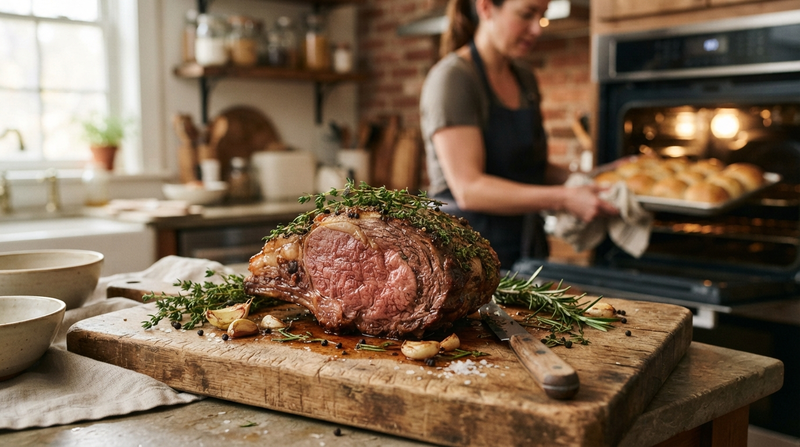
- Plan the rest and hold. A big roast needs time to rest before carving, which frees the oven for other dishes.
A sample oven timeline
| Stage | In the oven | Everything else |
|---|---|---|
| The day before | Bake the dessert or any dish that reheats well | Chop vegetables, make sauces, and assemble casseroles |
| Stage 1 | The roast alone, on a lower rack, at 350–375°F | Prepare sides on the counter and stovetop |
| Stage 2 | Add potatoes or a casserole on a second rack when the roast has roughly an hour left | Start the stovetop or slow-cooker dishes |
| Stage 3 | Remove the roast. Raise the heat to about 425°F for vegetables or rolls | Rest the roast, covered loosely with foil, for 20–30 minutes; make gravy |
| Stage 4 | Finish or reheat anything that needs it | Carve and serve; hold food at 140°F (60°C) or above |
Roasting times vary widely, so use a thermometer instead of the clock; see our thermometer guide. For menus, make-ahead plans, and food-safety advice for large meals, see our holiday meal ideas.
Use racks and pans well
- Put the largest item low. Roasts and large pans usually go on a lower-middle rack, leaving room above.
- Leave gaps. A common guideline is to leave an inch or two around pans so air can circulate.
- Stagger pans instead of stacking them directly over one another, so heat doesn’t get blocked.
- Rotate and swap. Halfway through, turn pans and switch their rack positions, because the top and back of most ovens run hotter.
- Don’t open the door often. Each opening drops the temperature, so check through the window when you can.
- Consider your pans. Dark metal browns faster, and glass holds heat differently; see our baking tips. A heavy sheet pan and a roasting pan are worth having; see our essential kitchen tools.
Get more from convection
A convection setting uses a fan to circulate hot air, which cooks food more evenly and often faster. It’s especially useful when you have pans on more than one rack.
- Adjust the recipe. The usual rule is to lower the temperature by about 25°F (15°C), or to shorten the cooking time by roughly 25%. Don’t apply both unless you know your oven, and check whether it converts automatically.
- Check early. Start testing for doneness before the original time, and use a thermometer for meat.
- Don’t block the fan. Leave space around pans, and avoid covering the oven with foil sheets that stop airflow.
- Use it selectively. It’s excellent for roasting, vegetables, and cookies on several racks, but may not suit delicate custards, some cakes, or covered dishes.
Add cooking space without a new oven
| Option | Good for | Limits |
|---|---|---|
| Countertop convection or air fryer oven | Small roasts, vegetables, rolls, reheating | Measure your pans first; capacity varies |
| Toaster oven | Small dishes and quick sides | Small cavity |
| Slow cooker | Stews, pulled meats, soups, mashed potatoes | Slow, so plan ahead |
| Electric roaster oven | Large roasts, poultry, baked potatoes | Needs counter space and a power outlet |
| Stovetop | Sauces, grains, vegetables, braises | Burners fill up quickly |
| Microwave | Reheating, steamed vegetables | Little browning |
| Outdoor grill | Meat and vegetables; see our outdoor kitchen guide | Weather and safety rules |
| Low oven or warming drawer | Keeping finished dishes warm | Holds food, doesn’t cook it |
Keep hot food at 140°F (60°C) or above, and don’t leave perishable food out for more than 2 hours.
Choose a menu that needs less oven
- One main oven dish, such as a roast or a big casserole.
- One or two stovetop or slow-cooker dishes. A pot of chili or a stew feeds a crowd without touching the oven.
- Something cold or room-temperature, such as a salad or marinated vegetables.
- A make-ahead dessert baked the day before.
If you’re buying an oven
This is general guidance, not a brand recommendation.
- Measure first. Check your largest roasting pan and sheet pan against the oven’s interior width, depth, and height, not just its listed capacity.
- Look at the racks. More rack positions give you flexibility.
- Consider convection, especially if you cook on multiple racks.
- Think about two ovens. A double oven lets you cook at two temperatures at once, and the smaller one handles everyday meals.
- Check the fit and utilities. Wall ovens and doubles need cabinet space and may need gas or electrical work, so ask a licensed professional.
- Check reviews and repair availability, and weigh the features against your budget.
Troubleshooting
- Food is browning unevenly: Rotate the pans and swap racks halfway through.
- Vegetables are steaming instead of roasting: The pan is crowded. Use two pans, or roast in two rounds.
- The sides are cold when the roast is ready: Plan a longer rest, raise the oven temperature during the rest, and use a low oven to hold finished dishes.
- The roast is dry: It may have gone past its target temperature. Remove it a little earlier next time, since it keeps cooking as it rests.
- Dishes don’t fit: Check pan sizes in advance, and switch to a smaller pan or a sheet pan.
FAQ
Do I need a double oven?
Not necessarily. If you regularly cook several dishes at different temperatures, it can help. Many cooks manage well with one oven and a countertop appliance.
Can I cook at different temperatures on different racks?
Not truly. The oven has one temperature, though the top runs hotter than the bottom. Choose a compromise temperature and adjust the time.
Can a countertop air fryer oven replace a second oven?
For small dishes, often. For large roasts or big pans, check whether they fit first.
How do I keep food warm?
Use a low oven, a warming drawer, or a slow cooker on warm, and keep hot food at 140°F (60°C) or above.
Conclusion
Cooking for a crowd is mostly about planning. Choose a shared temperature, give the roast time to rest, move some dishes to other appliances, and avoid crowding the oven. If you still run out of space, a second cooking surface will help more than a slightly larger cavity. And if you’re shopping, measure your pans first. A well-planned timeline can make an ordinary oven feed a large table.