

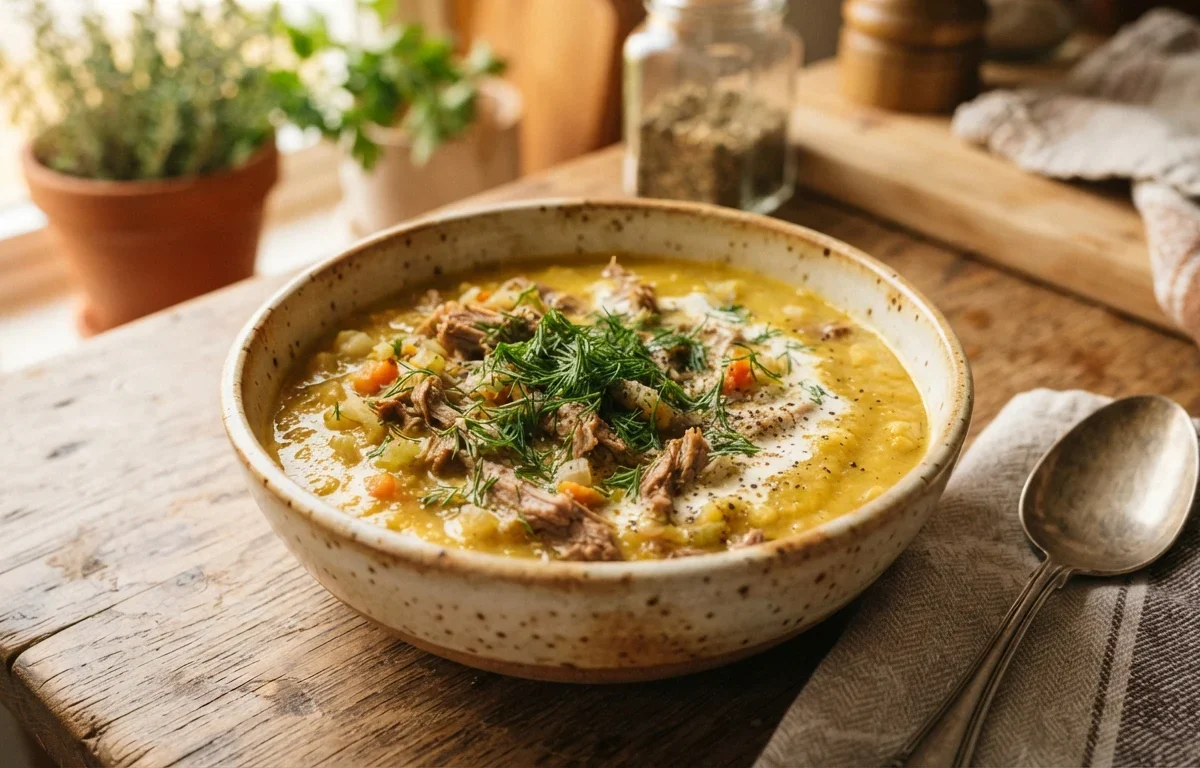
If you are looking for a comforting bowl of soup that feels rich without feeling heavy, this creamy meat and vegetable soup is a wonderful choice. By pressure-cooking the bone-in meat until it falls apart and blending the hearty vegetables into a velvety base, you get layers of deep, savory flavor in every spoonful. Don't worry if you've never blended a vegetable soup before—it's a simple technique that transforms everyday produce into a luxurious broth.
Why You'll Love This Recipe
- Bone-in meat cooks down until it is fork-tender and easily shreds into the soup.
- Cauliflower and potatoes create a naturally thick, velvety base without the need for heavy cream or flour.
- Turmeric gives the soup a warm, vibrant color that brightens up the entire bowl.
- Using an immersion blender lets you control the exact texture of your vegetable base right in the pot.
- Fresh dill adds a bright, herbal contrast to the rich, savory broth.
Ingredients You'll Need (and Why)
Bone-in beef shank, stew meat, or lamb: Using bone-in cuts brings rich collagen and depth to the cooking liquid as the meat breaks down, giving you a much more flavorful base than boneless meat alone.
Cauliflower florets: When cooked and blended, cauliflower breaks down into a smooth, creamy starch substitute that gives the soup its velvety texture without altering the savory flavor.
Potatoes: Peeled and cubed potatoes provide natural thickening power when puréed, ensuring the soup base has a hearty, satisfying body.
Turmeric: Beyond its earthy flavor, a teaspoon of turmeric lends a gorgeous, golden-yellow hue to the vegetable base, making the dish look as vibrant as it tastes.
Fresh dill or parsley: Stirred in at the very end, fresh herbs cut through the rich, slow-cooked broth with a burst of clean, bright flavor.
How to Make It
Cooking and Extracting Flavor from the Meat
Starting the meat in a pressure cooker or heavy pot allows connective tissues to break down completely. This not only yields exceptionally tender meat that shreds with ease, but it also creates a rich, mineral-dense broth that forms the flavorful foundation of the entire dish.
Building and Puréeing the Vegetable Base
Sautéing the onions, carrots, potatoes, and cauliflower with spices wakes up their natural sugars and infuses the olive oil with flavor. Simmering them in the reserved meat broth until fork-tender prepares them to be blended into a remarkably smooth, creamy consistency that coats the back of a spoon.
Bringing It All Together
Once the velvety vegetable base is achieved, folding the shredded meat and fresh dill back into the pot marries the robust protein with the creamy broth. A brief, gentle simmer allows all those distinct layers of seasoning to come together into a cohesive, deeply satisfying soup.
Success Tips
- Reserve all of the meat broth after cooking the protein—this nutrient-packed liquid is your main source of deep flavor for simmering the vegetables.
- Cut your potatoes and carrots into uniform sizes so they cook evenly and become tender at the same rate in the pot.
- Hold off on adding the fresh dill until the very end of cooking so it retains its bright green color and fresh flavor rather than turning dull from prolonged heat.
- Keep your immersion blender submerged beneath the surface of the liquid while blending to avoid hot splatters.
Variations
- Swap the beef shank for lamb shank for a slightly richer, more robust flavor profile.
- Use dried thyme instead of oregano if you prefer a more earthy, traditional herb note in your vegetable base.
Storage & Make-Ahead
Room temperature: Do not leave the soup at room temperature for longer than 2 hours.
Fridge: Store in an airtight container in the refrigerator for up to 3 to 4 days.
Freezer: Freeze in a freezer-safe container for up to 2-3 months. Thaw overnight in the refrigerator before reheating gently on the stovetop.
FAQ
Can I make this soup without a pressure cooker?
Yes. You can cook the bone-in meat in a standard large pot or Dutch oven over medium-low heat, though it will take longer (usually 1.5 to 2 hours) for the meat to become tender enough to fall off the bone.
What if I don't have an immersion blender?
You can carefully transfer the cooked vegetables and their cooking liquid in batches to a countertop blender. Be sure to remove the center piece of the blender lid and cover it with a towel to let steam escape safely, then blend until smooth and pour back into the pot.
Can I use boneless meat for this recipe?
You can, but using bone-in cuts significantly enhances the flavor of the broth as the bones release gelatin and savory compounds during the long cooking process.